Which Computer Course Is Best For B.Com Students? Explore Skills, Jobs & Career Opportunities
Explore the best computer courses for B.Com students to build practical skills in accounting, finance, data analytics, office management and digital marketing. Discover career opportunities, job-ready skills and how to choose the right course based on your career goals.
Introduction
Completing a Bachelor of Commerce (B.Com) degree gives students a strong foundation in accounting, finance, business management and taxation. However, having a commerce degree alone may not always be enough to meet the practical requirements of today's job market. Employers also look for candidates who can use accounting software, manage spreadsheets, prepare reports and handle digital business operations.
This is why learning the right computer course can make a difference in your career. Whether you want to work in accounting, banking, finance, office administration or data analytics, developing computer skills can improve your professional opportunities.
But which computer course is best for B.Com students?
The answer depends on your career interests and the skills you want to develop. Let's explore the most useful computer courses, their career opportunities and how to choose the right one after B.Com.
Why Do B.Com Students Need Computer Skills in Today's Job Market?
Most businesses now depend on digital tools to manage their daily operations. Accounting records, financial reports, employee information, invoices and business data are increasingly handled through computer applications.
For B.Com students, computer knowledge is particularly important because many commerce-related jobs involve working with digital accounting systems and financial information.
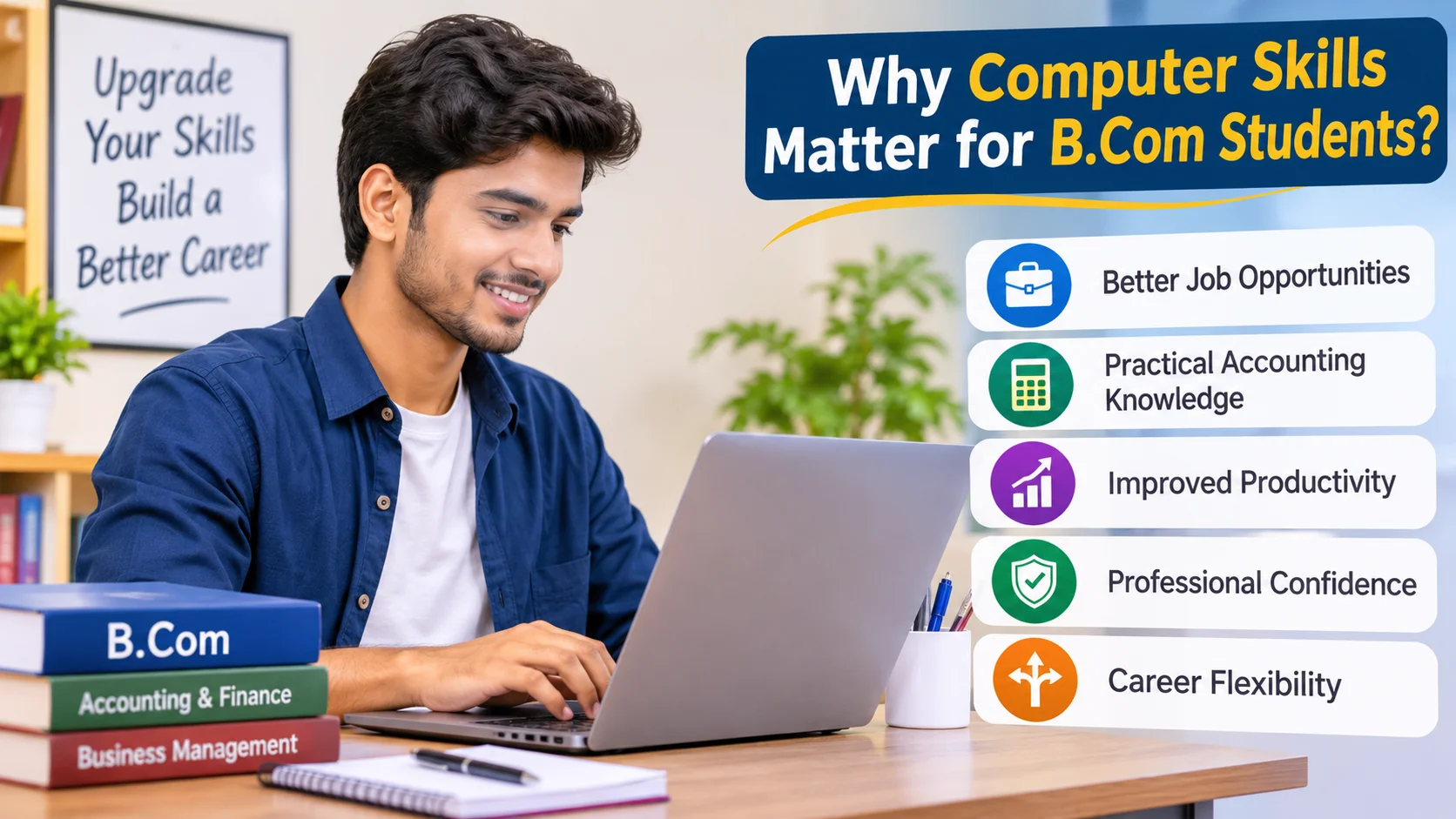
Here are some reasons why computer skills matter:
·Better job opportunities: Computer knowledge can help you qualify for accounting, finance, administration and back-office positions.
·Practical accounting knowledge: Accounting software helps you understand how businesses maintain financial records and manage transactions.
·Improved productivity: Excel and office applications make calculations, reporting and documentation easier.
·Professional confidence: Knowledge of business software helps you handle workplace responsibilities more effectively.
·Career flexibility: Digital skills allow commerce graduates to explore different professional fields.
Therefore, combining your B.Com qualification with relevant computer training can help you build a more job-ready profile.
Which Computer Course Is Best for B.Com Students?
Several computer courses can be useful for commerce graduates. However, the best option depends on whether you are interested in accounting, finance, office management, marketing or technology.
Let's understand the most relevant options.
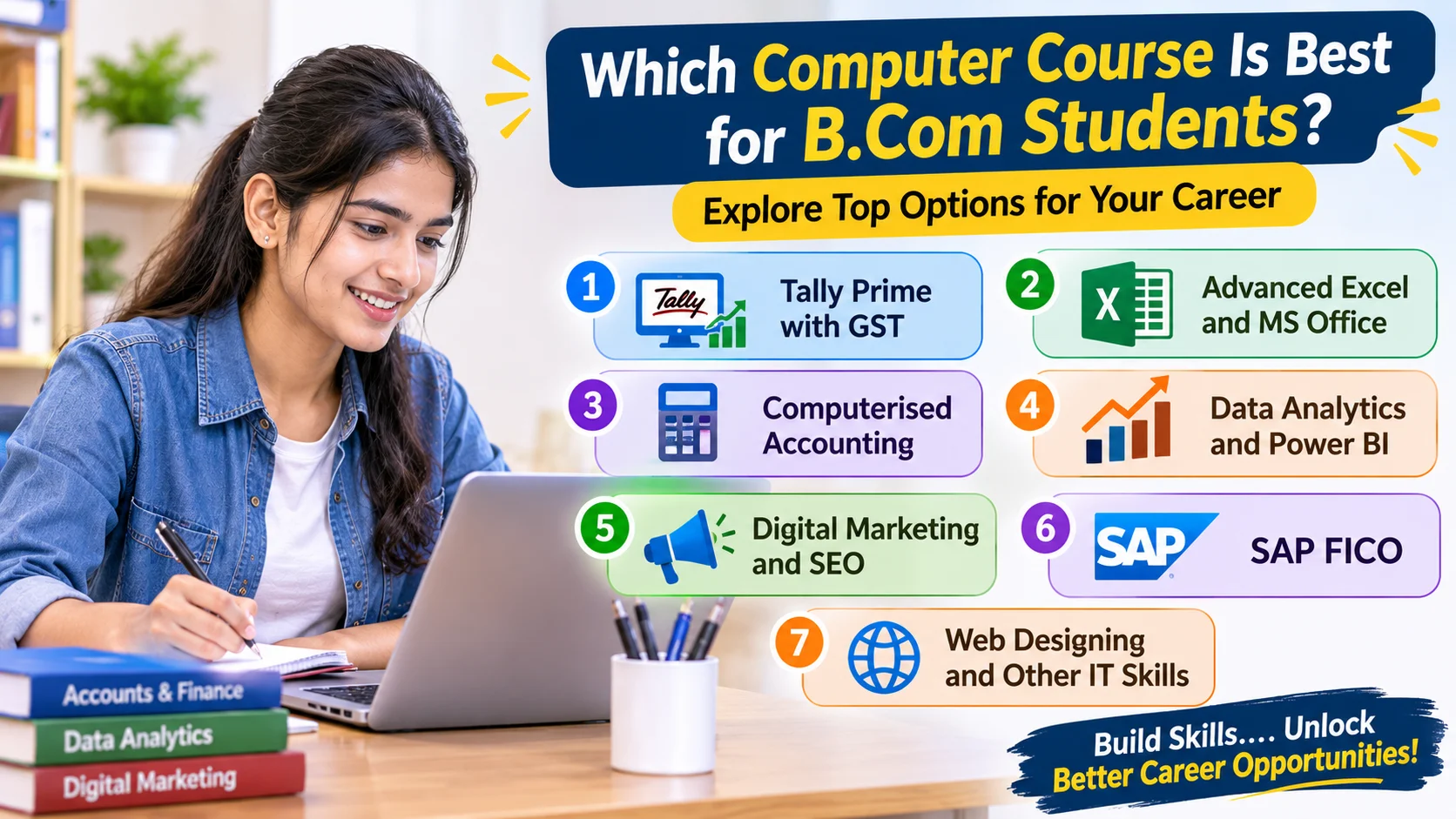
1. Tally Prime with GST
Tally Prime with GST is one of the most relevant computer courses for B.Com students interested in accounting and taxation.
It helps learners understand how businesses maintain accounts and manage financial transactions using accounting software.
Important topics include:
·Company creation and accounting configuration
·Ledger and group creation
·Voucher entries and accounting transactions
·GST concepts and tax-related entries
·Inventory management
·Financial statements and accounting reports
·Payroll fundamentals
After learning Tally Prime, you can explore opportunities such as accounts assistant, junior accountant, billing executive and accounting operator.
2. Advanced Excel and MS Office
Advanced Excel and MS Office are valuable skills for almost every commerce graduate.
Excel is widely used for organising financial information, preparing reports, analysing business data and managing records.
A good Excel course should cover:
·Basic and advanced formulas
·IF, SUMIF and COUNTIF functions
·VLOOKUP and XLOOKUP
·Pivot Tables
·Charts and data visualisation
·Data sorting and filtering
·Conditional formatting
MS Word and PowerPoint are equally useful for preparing professional documents, reports and presentations.
These skills can help you explore office assistant, MIS executive, back-office executive and data management positions.
3. Computerised Accounting
Computerised Accounting focuses on managing financial records through accounting software and digital systems.
It combines traditional accounting knowledge with practical computer applications.
Students can develop an understanding of bookkeeping, journal entries, ledgers, financial statements, taxation concepts and accounting reports.
This course is particularly relevant for students who want to work in accounting firms, finance departments, business organisations or small and medium-sized companies.
4. Data Analytics and Power BI
Data Analytics is an interesting career option for B.Com students who enjoy working with numbers and business information.
Businesses use data to understand financial performance, customer behaviour, sales trends and operational activities.
A beginner-friendly learning path may include:
·Advanced Excel
·Data cleaning and organisation
·SQL fundamentals
·Power BI
·Data visualisation
·Business reporting
·Basic analytical thinking
Power BI helps users transform data into interactive reports and dashboards.
With the right training and practical experience, you can explore roles such as junior data analyst, reporting analyst and business intelligence trainee.
A technical background is not compulsory to begin learning data analytics, although consistent practice and logical thinking are important.
5. Digital Marketing and SEO
Digital Marketing is another career option for B.Com students interested in business growth, online promotion and customer engagement.
Businesses use digital platforms to promote their products, reach customers and generate leads.
A digital marketing course may cover:
·Search Engine Optimisation (SEO)
·Social media marketing
·Google Ads fundamentals
·Content marketing
·Email marketing
·Website analytics
·Digital campaign planning
Commerce graduates can use their understanding of business and marketing to develop skills for digital marketing executive, SEO executive, social media executive and marketing assistant roles.
6. SAP FICO
SAP FICO stands for Financial Accounting and Controlling. It is an important module within SAP ERP systems used by businesses to manage financial processes.
It is particularly relevant for commerce graduates who want to explore enterprise-level accounting and finance systems.
The learning areas may include:
·General Ledger Accounting
·Accounts Payable
·Accounts Receivable
·Asset Accounting
·Cost Centre Accounting
·Financial reporting
SAP FICO can be a suitable specialisation for students with a clear interest in corporate finance and enterprise resource planning.
However, learners should understand basic accounting concepts before moving into specialised SAP training.
7. Web Designing and Other IT Skills
B.Com students who want to explore careers beyond traditional commerce can also consider web designing and other IT-related skills.
Web designing generally involves learning HTML, CSS and basic JavaScript to create and manage websites.
These skills may lead towards website design, website maintenance and entry-level web development opportunities.
However, web designing requires regular practice and an interest in technology. It is a different career direction from accounting and finance.
Which Computer Course Should You Choose Based on Your Career Goal?
Choosing a course becomes easier when you first identify your professional interests.
Here is a simple guide:
For Accounting and Finance Jobs
If you want to work in accounting, taxation or finance, prioritise:
·Tally Prime with GST
·Computerised Accounting
·Advanced Excel
·SAP FICO
These skills can help you understand accounting software, financial transactions and business reporting.
For Office and MIS Jobs
If you prefer administrative and office-based responsibilities, consider:
·Advanced Excel
·MS Office
·Data Entry and Management
·Basic Computer Applications
These skills are useful for documentation, spreadsheets, reporting and office administration.
For Data Analytics Careers
If you enjoy analysing numbers and business information, consider:
·Advanced Excel
·SQL
·Power BI
·Data Analytics fundamentals
Start with Excel and gradually move towards more advanced analytical tools.
For Digital Marketing Careers
If you are interested in online business promotion, choose:
·SEO
·Social Media Marketing
·Google Ads
·Content Marketing
·Website Analytics
These skills can help you understand how businesses attract and engage customers online.
For Students Interested in IT
If you want to move towards the technology sector, explore:
·HTML and CSS
·JavaScript
·Python fundamentals
·Web Designing
·Programming Basics
Choose a structured learning path and give yourself enough time for practical development.
What Skills Should a B.Com Student Learn to Become Job-Ready?
Apart from completing a computer course, B.Com students should focus on developing a combination of technical and professional skills.
Some important skills include:
1.Accounting Knowledge: Understand basic accounting principles, bookkeeping and financial statements.
2.Excel Proficiency: Learn formulas, data management, Pivot Tables and reporting.
3.Accounting Software: Develop practical knowledge of tools such as Tally Prime.
4.Communication Skills: Improve professional speaking, writing and email communication.
5.Data Management: Learn to organise, maintain and analyse business information.
6.Problem-Solving: Develop the ability to understand problems and find suitable solutions.
7.Professional Computer Usage: Become comfortable with office applications, digital documentation and internet-based tools.
Remember, employers generally value your ability to perform practical tasks, not simply the number of certificates you have completed.
What Jobs Can You Get After Learning Computer Courses?
After completing B.Com and learning relevant computer skills, you can explore different entry-level career opportunities.
Some possible job roles include:
|
Computer Skills |
Possible Job Roles |
|
Tally Prime and GST |
Accounts Assistant, Billing Executive |
|
Advanced Excel |
MIS Executive, Data Executive |
|
Computerised Accounting |
Junior Accountant, Accounts Executive |
|
Data Analytics and Power BI |
Junior Data Analyst, Reporting Analyst |
|
Digital Marketing |
SEO Executive, Digital Marketing Executive |
|
SAP FICO |
SAP FICO Trainee, Finance Process Associate |
|
Web Designing |
Junior Web Designer, Website Assistant |
These are potential career paths, not guaranteed job outcomes. Actual opportunities depend on your practical knowledge, communication skills, experience and employer requirements.
How to Choose the Right Computer Course After B.Com?
Before enrolling in any computer course, consider the following points:
1. Identify Your Career Interest: Decide whether you want to work in accounting, finance, administration, analytics, marketing or IT.
2. Check the Course Syllabus: Make sure the course covers the tools and topics relevant to your career goal.
3. Prioritise Practical Training: Choose training that includes regular computer practice rather than only theoretical explanations.
4. Check the Learning Level: Beginners should build basic computer knowledge before moving to advanced software.
5. Compare Training Institutes: Check the curriculum, trainer support, learning environment and available practical facilities.
6. Focus on Real Skills: Select a course that helps you perform actual workplace tasks and build professional confidence.
A carefully selected course can be more useful than enrolling in multiple unrelated computer programmes.
How Can EEPL Classroom Ranchi Help You?
If you are a B.Com student or graduate looking to improve your computer knowledge, EEPL Classroom Ranchi provides a learning environment for exploring computer applications and technology-related skills.
Choosing the right training programme should begin with understanding your current knowledge and future career interests.
Depending on your learning requirements and currently available course offerings, you can explore relevant computer training options covering areas such as computer applications, MS Office, accounting software and other digital skills.
Before enrolling, discuss your career goals with the EEPL Classroom team and ask about the latest syllabus, practical training, course duration and eligibility.
This will help you identify a suitable learning path instead of choosing a course simply because it is popular.
Visit the official website to explore available learning opportunities: https://eepl.me/
Conclusion
Choosing the best computer course for B.Com students depends on your career goals and professional interests.
If you want to build a career in accounting, Tally Prime with GST and Computerised Accounting can be useful choices. For office and MIS roles, Advanced Excel and MS Office are valuable. Students interested in business intelligence can explore Data Analytics and Power BI, while those interested in online business promotion can consider Digital Marketing.
The most important thing is to develop practical skills that complement your commerce education.
Start by identifying your career direction, select a relevant computer course and practise regularly. With the right combination of academic knowledge, technical skills and professional confidence, you can prepare yourself for a wider range of career opportunities.
FAQs
1. Which computer course is best for B.Com students?
Tally Prime with GST, Advanced Excel and Computerised Accounting are useful choices for B.Com students. Those interested in analytics or marketing can also explore Power BI and Digital Marketing.
2. Which computer course is best after B.Com for getting a job?
Tally Prime with GST and Advanced Excel are practical starting options for students seeking accounting and office-related jobs. The best choice depends on the job role you want to pursue.
3. Is Tally with GST useful for B.Com students?
Yes. Tally with GST helps B.Com students understand computerised accounting, financial transactions, bookkeeping and GST-related accounting processes. It can be useful for entry-level accounting positions.
4. Can a B.Com student learn Data Analytics without a technical background?
Yes. B.Com students can start learning Data Analytics without a technical degree. Beginning with Excel and gradually learning SQL and Power BI can provide a structured learning path.
5. Which computer skills are required for accounting and office jobs?
Important skills include Tally Prime, GST fundamentals, Advanced Excel, MS Word, email communication, data entry and basic computer operations. The exact requirements depend on the responsibilities of the job.
For More Information and Updates, Connect With Us
·Contact No: +91 9031685211
·Email ID:emancipationedutech@gmail.com
·Websites:https://eepl.me
·Instagram:https://www.instagram.com/eepl.classroom/?hl=en
·Facebook:https://www.facebook.com/eeplclassroom
·YouTube:www.youtube.com/@EEPLClassroom
·Live Location:https://share.google/V2XZnzegHrzmbbQJQ
·Blog:https://eepl.me/blog
·Address: 203, Hariom Tower, Circular Rd, Lalpur, Ranchi, Jharkhand 834001