What is Machine Learning? A Beginner's Guide to AI Careers
What is machine learning and how does it work? Explore machine learning for beginners, career opportunities, salary in India, and how to start your AI journey with EEPL Classroom in Ranchi.
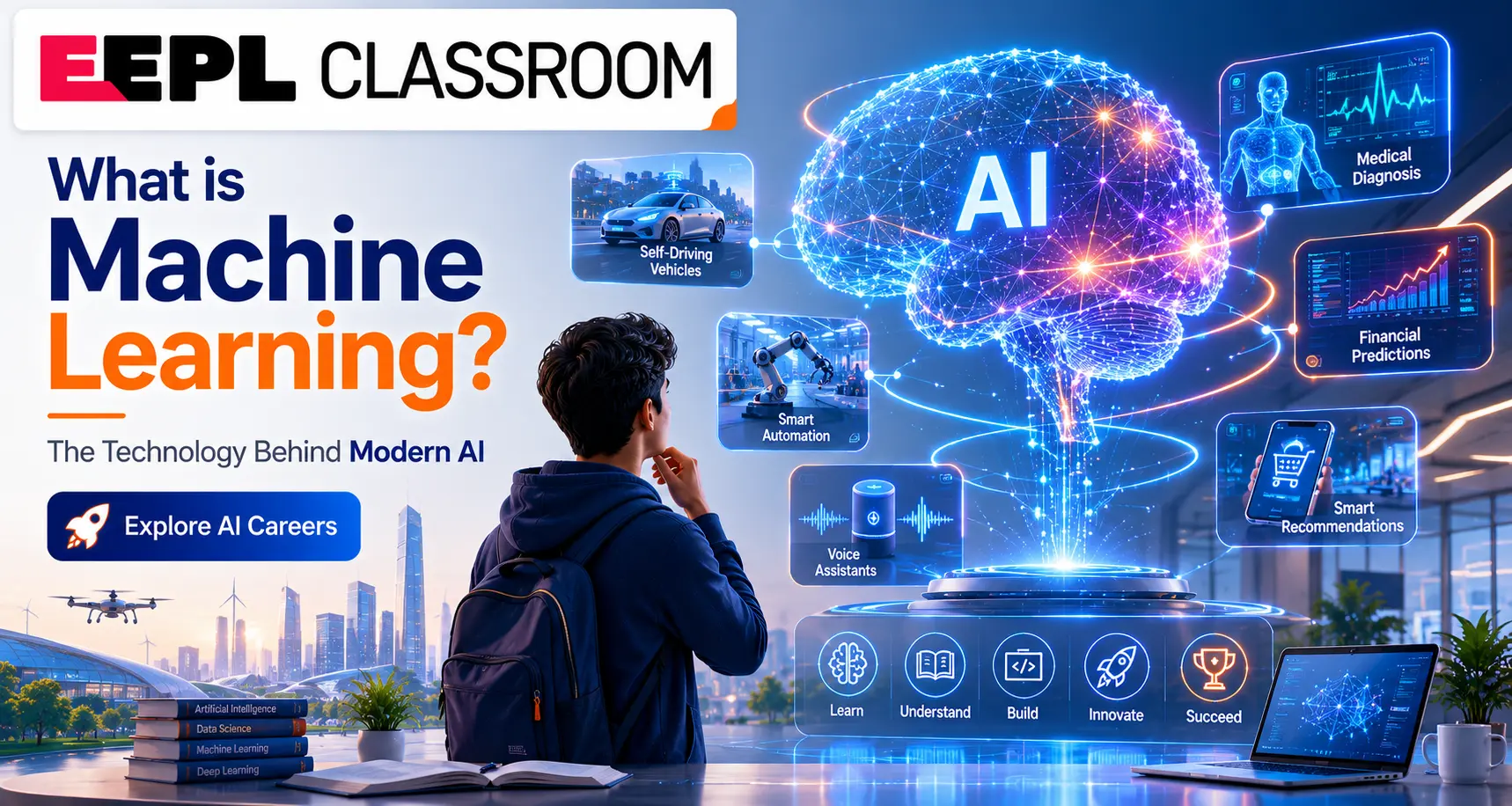
What is Machine Learning? It is one of the most searched questions by students and freshers in India today and for good reason. Machine learning is reshaping industries, creating new job roles, and redefining the future of work. Whether you are a college student exploring career options or a working professional looking to switch fields, understanding machine learning explained in simple terms is your first step. At EEPL Classroom, we help beginners in Ranchi and across Jharkhand take that first step with confidence.
What is Machine Learning? The Simple Definition
Machine learning (ML) is a branch of artificial intelligence (AI) that enables computers to learn from data and improve their performance over time without being explicitly programmed for every task. Think of it this way: instead of writing thousands of rules, you feed data to a system, and the system learns the patterns on its own.
The term was coined by Arthur Samuel in 1959, but it is only in the last decade that machine learning applications have exploded into everyday life from Netflix recommendations and Google Search to fraud detection in banking and disease diagnosis in healthcare.
In the simplest words: machine learning is how machines get smarter by learning from experience.
What is Machine Learning and How Does It Work?
Understanding how machine learning works is easier when you break it into three steps:
Input Data: The system receives large volumes of raw data; images, text, numbers, or audio.
Training: Algorithms process this data, identify patterns, and build a predictive model.
Output/Prediction: The trained model makes decisions or predictions on new, unseen data.
For example, a spam filter is trained on thousands of emails labelled "spam" or "not spam." Over time, it learns to recognise spam patterns and filters them automatically. This is machine learning for beginners with examples; simple, practical, and everywhere around us.
There are three main types of machine learning:
Supervised Learning: The model learns from labelled data (e.g., image classification).
Unsupervised Learning: The model finds hidden patterns in unlabelled data (e.g., customer segmentation).
Reinforcement Learning: The model learns by trial and error, receiving rewards or penalties (e.g., game-playing AI).
Machine Learning vs Artificial Intelligence | What is the Difference?
Many beginners use machine learning and artificial intelligence interchangeably, but they are not the same thing.
Artificial intelligence (AI) is the broader concept of machines performing tasks that would normally require human intelligence — reasoning, problem-solving, language understanding, and perception. Machine learning is a subset of AI, meaning it is one of the methods through which AI is achieved.
Here is a clear way to understand it:
AI is the goal of making machines intelligent.
Machine Learning is the approach teaching machines to learn from data.
Deep Learning goes one level deeper, it is a subset of ML that uses neural networks modelled on the human brain.
So when someone asks about machine learning vs artificial intelligence, the answer is: ML is a powerful tool within the larger AI ecosystem. Every ML system is an AI system, but not every AI system uses machine learning.
Machine Learning Applications in the Real World
Machine learning applications are no longer limited to tech companies. They are embedded in virtually every sector:
Healthcare: Predicting disease risk, analysing medical images, personalising treatment plans.
Finance: Detecting fraud, automating trading, assessing loan risk.
E-commerce: Product recommendations, dynamic pricing, inventory management.
Education: Personalised learning paths, automated grading, student performance prediction.
Agriculture: Crop disease detection, yield prediction, precision farming.
Manufacturing: Predictive maintenance, quality control, supply chain optimisation.
According to Google AI research, machine learning is already transforming how businesses operate at scale. Microsoft Learn also reports that AI and ML competency is rapidly becoming a baseline requirement across job roles, not just in technology.
Is Machine Learning a Good Career in India?
Yes, and the data strongly supports this. Machine learning as a career is one of the highest-growth professional paths available to students in India today.
According to NASSCOM, India's demand for AI and data science professionals is expected to reach over 1 million by 2026. Machine learning jobs are among the most well-compensated roles in the Indian tech market, with starting packages that often outpace traditional software development roles.
Machine learning salary in India varies by role and experience:
Entry-level ML Engineer: ₹4–8 LPA
Mid-level ML Engineer: ₹10–18 LPA
Senior ML Engineer / Data Scientist: ₹20–40+ LPA
Career opportunities in machine learning span across multiple designations:
Machine Learning Engineer
Data Scientist
AI Research Scientist
Natural Language Processing (NLP) Engineer
Computer Vision Engineer
Data Analyst
Business Intelligence (BI) Analyst
AI careers are not limited to engineering graduates either. Students from science, commerce, and even arts backgrounds can transition into ML roles with the right training in programming, mathematics, and data handling.
Is Machine Learning a Good Career After 12th?
Absolutely. Machine learning after 12th is a realistic and rewarding path for students who are willing to invest time in learning the fundamentals. You do not need a degree in computer science to begin. Starting with Python, mathematics basics, and structured ML training gives you a strong foundation and that is exactly what EEPL Classroom is designed for.
Start Your AI Career Journey with EEPL Classroom
If you are exploring AI careers and want structured, mentor-led training, EEPL Classroom offers a practical Machine Learning Course in Ranchi designed specifically for beginners and students. From Python fundamentals to real-world ML projects, our curriculum is built to make you job-ready. Enroll today and take the first step toward a future in artificial intelligence.
Machine Learning Roadmap for Beginners | Where Do You Start?
A common question from beginners is: "I want to learn ML — but where do I begin?" Here is a practical machine learning roadmap for beginners:
Step 1: Learn Python
Python is the primary programming language for machine learning. Its simple syntax, rich libraries (NumPy, Pandas, Scikit-learn, TensorFlow), and large community make it the best starting point. Enrol in a Python Course in Ranchi to build a strong programming base before moving into ML.
Step 2: Build Your Mathematics Foundation
Linear algebra, statistics, probability, and calculus form the backbone of ML algorithms. You do not need to master all of advanced mathematics; a working understanding of these concepts is sufficient for most ML applications.
Step 3: Understand Core ML Algorithms
Begin with foundational algorithms:
Linear Regression and Logistic Regression
Decision Trees and Random Forests
K-Nearest Neighbours (KNN)
Support Vector Machines (SVM)
K-Means Clustering
Neural Networks basics
The TensorFlow Documentation is a valuable free resource for learners who want to understand implementation alongside concepts.
Step 4: Work on Real Projects
Build a portfolio. Use real datasets from Kaggle, UCI Machine Learning Repository, or public government datasets. Projects show employers that you can apply skills — not just understand them in theory.
Step 5: Learn Data Analytics and Visualisation
Data analytics is closely connected to ML. Understanding how to clean, explore, and visualise data using tools like Pandas, Matplotlib, and Power BI gives you a critical edge. Pair ML learning with a Data Analytics Course for a comprehensive skill set.
Step 6: Explore Complementary Technologies
Learning Java can be valuable for backend ML deployment. Understanding databases, APIs, and cloud platforms like AWS and Google Cloud also strengthens your profile. A Java Course in Ranchi can add significant weight to your overall technical competency.
Ready to Begin? EEPL Classroom Has the Right Path for You
Whether you are a student exploring ML for the first time, a fresher building your resume, or a professional looking to upskill EEPL Classroom offers structured training programmes in machine learning, Python, data analytics, and computer applications. Our ADCA Course in Ranchi also serves as an excellent entry point for students who want a broad foundation in computer applications before specialising. Speak to our team today and get a personalised learning plan.
How to Become a Machine Learning Engineer
Becoming a machine learning engineer requires a combination of technical skills, hands-on projects, and domain knowledge. Here is what employers look for:
Technical Skills:
Proficiency in Python (mandatory)
Knowledge of ML frameworks; TensorFlow, Keras, PyTorch, Scikit-learn
Understanding of data structures and algorithms
Familiarity with SQL and databases
Experience with cloud platforms (AWS, GCP, Azure)
Version control using Git and GitHub
Soft Skills:
Analytical thinking and problem-solving
Communication (explaining ML outputs to non-technical stakeholders)
Curiosity and continuous learning
The machine learning engineer role is consistently ranked among the top ten most in-demand jobs globally. Platforms like LinkedIn, Naukri, and Indeed regularly list hundreds of open positions across Indian cities including Bangalore, Hyderabad, Pune, and Delhi NCR.
Machine Learning Training in Ranchi | Learn Locally, Grow Globally
For students and professionals based in Ranchi and surrounding districts of Jharkhand, finding quality machine learning training locally has historically been a challenge. Most learners either had to relocate to metro cities or depend entirely on online platforms with no mentorship support.
EEPL Classroom bridges this gap. Located at Abhinandan Complex, Tharpakhna, Near Govt. Women's Polytechnic, Ranchi, offers hands-on, mentor-led training in machine learning, Python, and data analytics right in the heart of Jharkhand's capital.
Our machine learning course in Ranchi is designed for:
Students from Class 11, 12, and college pursuing BCA, B.Sc, B.Tech, or MCA
Graduates and freshers preparing for tech jobs
Working professionals looking to upskill in AI and data science
Career switchers from non-tech backgrounds
We also offer an AI course in Ranchi that covers foundational artificial intelligence concepts alongside practical ML training. Combined with our Python course in Ranchi and data analytics course in Ranchi, students receive end-to-end preparation for high-demand technology roles.
At EEPL Classroom, we don't just teach, we mentor. Our faculty brings real-world experience in ML and data science, and our curriculum is updated regularly to reflect current industry demands and hiring trends. Reach us at +91 98351 31568 or visit eepl.me to explore our courses.
The Future of Machine Learning | What Lies Ahead?
The future of machine learning is extraordinary. Here are some key trends shaping the next decade:
Generative AI: Tools like ChatGPT and Google Gemini are making ML more accessible and more powerful simultaneously.
AutoML: Automated machine learning platforms are reducing barriers for non-programmers.
Edge AI: ML models running on mobile devices and IoT hardware, not just cloud servers.
Explainable AI (XAI): Growing demand for transparent, interpretable ML models in regulated industries.
AI in Governance and Public Policy: Governments worldwide are exploring ML for healthcare, agriculture, and urban planning.
The future scope of machine learning in India is particularly strong. With government initiatives like Digital India, the National AI Strategy, and growing investment in tech startups, professionals with ML expertise will be in continuous demand across sectors.
Explore Your Future With a Career Counselling Session at EEPL Classroom
Unsure which path is right for you; machine learning, data analytics, Python development, or a broader computer course? EEPL Classroom offers personalised career counselling sessions to help students and professionals identify the right learning path based on their background, goals, and interests. Contact us today and make your next step count.
Frequently Asked Questions About Machine Learning
What is machine learning in simple words?
Machine learning is a type of artificial intelligence where computers learn from data and improve their performance over time without being explicitly programmed. Instead of following fixed rules, a machine learning system identifies patterns and makes decisions based on what it has learned.
What is the difference between machine learning and artificial intelligence?
Artificial intelligence is the broader concept of machines performing intelligent tasks. Machine learning is a subset of AI. It is one specific method used to achieve AI, where systems learn from data rather than following pre-programmed rules.
Is machine learning a good career option in India?
Yes. Machine learning is one of the highest-paying and fastest-growing career fields in India. Entry-level roles start at ₹4–8 LPA, and experienced professionals earn ₹20–40 LPA or more. Demand is strong across IT, banking, healthcare, e-commerce, and manufacturing sectors.
Can I learn machine learning after Class 12?
Yes. Machine learning after 12th is entirely possible. You can begin with foundational computer and Python courses, build your mathematics understanding, and progressively move into ML concepts. EEPL Classroom in Ranchi offers a beginner-friendly pathway tailored for students at this stage.
What programming language is used in machine learning?
Python is the most widely used programming language in machine learning. It has powerful libraries like NumPy, Pandas, Scikit-learn, TensorFlow, and Keras that simplify the process of building and deploying ML models.
How long does it take to learn machine learning?
With consistent effort, a beginner can develop a solid working knowledge of machine learning fundamentals in 6–12 months. This includes Python basics, core ML algorithms, and hands-on project experience. Joining a structured course significantly shortens this timeline.
What jobs can I get with machine learning skills?
With machine learning skills, you can pursue roles such as ML Engineer, Data Scientist, AI Engineer, NLP Engineer, Computer Vision Engineer, Data Analyst, and Business Intelligence Analyst across industries in India and globally.
Do I need a degree to become a machine learning engineer?
A formal degree in computer science or engineering is helpful but not mandatory. Many successful machine learning engineers have built their careers through certifications, self-study, bootcamps, and practical projects. Skills and portfolio matter more than degrees in most ML hiring processes.
What is the future scope of machine learning in India?
India's demand for AI and ML professionals is projected to exceed 1 million by 2026 (NASSCOM). With rising investment in technology, government AI initiatives, and a growing startup ecosystem, the future scope of machine learning in India is exceptional.
Where can I learn machine learning in Ranchi?
EEPL Classroom in Ranchi offers a structured, mentor-led machine learning course at Abhinandan Complex, Tharpakhna, Near Govt. Women's Polytechnic, Ranchi – 834001. We also offer Python training, data analytics, and career counselling. Call us at +91 98351 31568 or visit eepl.me.
Final Thoughts | Your Machine Learning Journey Starts Here
Machine learning is not just a technology trend, it is a foundational skill for the careers of tomorrow. Whether your goal is to become a machine learning engineer, transition into AI careers, or simply understand how intelligent systems work, the time to start is now.
The good news is that you do not need to be a genius or a coding wizard to get started. You need curiosity, the right guidance, and a structured learning plan. EEPL Classroom in Ranchi has helped hundreds of students and professionals build exactly that.
Start your beginner guide to machine learning journey today. Your future in AI is one step away.