What is Data Analytics and Why is it Important?
What is Data Analytics and why does it matter? Learn the meaning, benefits, applications, career scope, and how beginners can start learning Data Analytics at EEPL Classroom Ranchi.
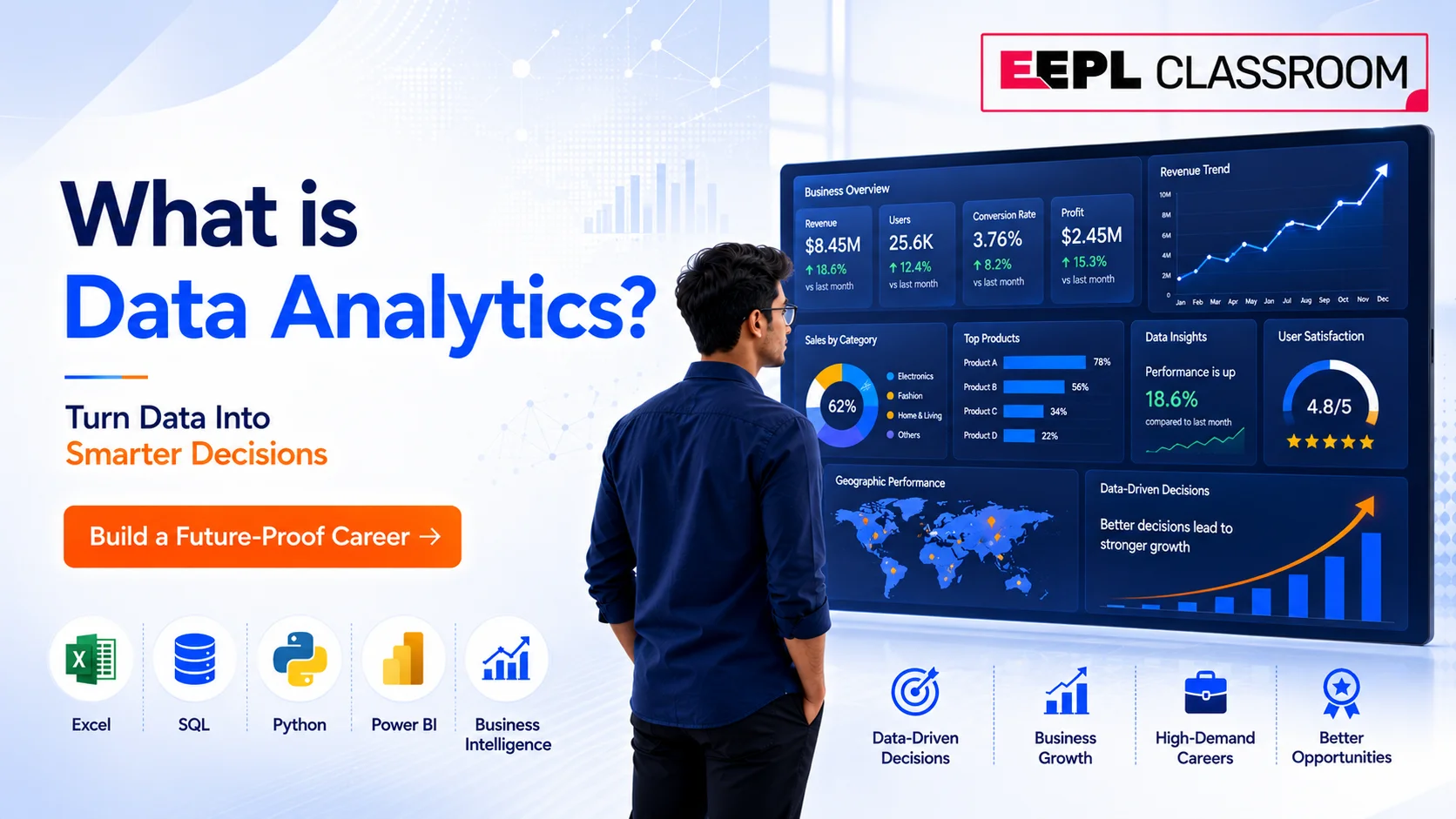
Every business decision made today, whether it is launching a product, hiring staff, setting prices, or targeting customers is increasingly backed by data. Understanding what is data analytics has therefore become one of the most valuable pieces of knowledge a student, professional, or career switcher can have in 2026. At EEPL Classroom, we introduce hundreds of beginners each year to this field, and the first question we always address is the most fundamental one. Data analytics is the process of collecting, organising, cleaning, analysing, and interpreting data to discover useful insights and support data driven decision making. If you have ever wondered why data analytics is important and how it can shape your career, this guide is your starting point.
What is Data Analytics?
Data Analytics is the systematic process of examining raw data to draw conclusions, identify patterns, and generate actionable insights. It sits at the intersection of statistics, technology, and business strategy and its applications span every industry imaginable.
In simple terms, data analytics answers questions that businesses and organisations cannot answer by instinct alone. How many customers are likely to leave next month? Which product is generating the highest profit margin? Which region should we expand into next? These are questions that raw data, when properly analysed, can answer with remarkable accuracy.
The term data analytics is often used interchangeably with data analysis, though analytics tends to refer more broadly to the discipline including tools, processes, and framework, while analysis refers to the specific act of examining data. For beginners, the distinction is minor. What matters is understanding how the process works and why it is so widely adopted.
What is Data Analytics and Why is it Important?
This question captures the exact intent of most people searching for this topic, and it deserves a direct, thorough answer.
Data Analytics is important because it transforms raw, unstructured information into meaningful knowledge. In the modern world, every digital interaction generates data — every click, purchase, search, call, and transaction. Without the ability to analyse this data, it is just noise. With it, businesses gain a significant competitive advantage.
Here is a concise snapshot of what data analytics enables:
Improved efficiency: identifying bottlenecks and eliminating waste in operations
Better understanding of customer behaviour: knowing what customers want before they ask
Increased revenue: targeting the right products to the right people at the right time
Risk reduction: detecting fraud, predicting failures, and managing uncertainty
Smarter decision making: replacing guesswork with evidence-backed strategy
According to NASSCOM, data and analytics is one of the fastest growing segments of India's technology industry, with demand for skilled professionals significantly outpacing supply. This gap represents a massive career opportunity for anyone who invests in learning data analytics today.
Want to build a career in Data Analytics? EEPL Classroom offers structured, beginner-friendly training in Ranchi. Speak with our counselors and find the right starting point for your journey.
Types of Data Analytics
Understanding the field begins with recognising that data analytics is not a single activity, it is a spectrum of approaches, each serving a different purpose.
Descriptive Analytics
Descriptive analytics is the most foundational type. It answers the question: What happened? It summarises historical data to give a clear picture of past performance. Monthly sales reports, website traffic summaries, and social media engagement statistics are all examples of descriptive analytics at work.
Diagnostic Analytics
Diagnostic analytics goes one step deeper and asks: Why did it happen? It examines the relationships between variables to identify the root causes behind trends or anomalies. If sales dropped last quarter, diagnostic analytics helps pinpoint whether it was due to pricing, competition, supply issues, or seasonal factors.
Predictive Analytics
Predictive analytics uses historical data and statistical models to answer: What is likely to happen? This is where tools like Machine Learning and statistical forecasting come into play. Banks use predictive analytics to assess loan default risk. Retailers use it to forecast inventory needs. Healthcare providers use it to identify patients at risk of specific conditions.
H3: Prescriptive Analytics
Prescriptive analytics is the most advanced type and answers: What should we do about it? It not only predicts outcomes but also recommends the optimal course of action. This is the frontier of data analytics and is closely tied to Artificial Intelligence and advanced Machine Learning models.
Benefits of Data Analytics in Business
The benefits of data analytics are tangible and wide-reaching. Here is how organisations across different sectors experience them.
Retail and E-commerce companies use data analytics to personalise product recommendations, optimise pricing strategies, and reduce cart abandonment. Platforms like Amazon and Flipkart run millions of micro-decisions every day powered entirely by data.
Banking and Financial Services firms rely on analytics for fraud detection, credit scoring, regulatory compliance, and investment risk assessment. The ability to detect anomalies in transaction data in real time has saved the industry billions of rupees annually.
Healthcare providers use data driven decision making to improve patient outcomes, manage hospital resources, track disease patterns, and accelerate drug discovery. Data analytics played a critical role in pandemic response planning across countries worldwide.
Manufacturing and Logistics companies use analytics to optimize supply chains, predict equipment failures before they happen, and improve delivery accuracy. This field — known as predictive maintenance — is one of the fastest growing applications of industrial analytics.
Marketing and Digital Media professionals use analytics to measure campaign performance, understand audience segments, and allocate budgets where they deliver the highest return on investment.
According to Microsoft Learn, integrating data analytics tools into business workflows — particularly through platforms like Power BI and Azure Synapse Analytics dramatically improves the speed and accuracy of business intelligence reporting.
Data Analytics Tools and Technologies
Knowing the tools used in data analytics is an important part of understanding the field. The most widely used technologies include:
Python: the leading programming language for data analysis, supported by libraries like Pandas, NumPy, Matplotlib, and Seaborn
SQL: the standard language for querying and managing databases
Power BI: Microsoft's business intelligence and data visualisation platform
Excel: still widely used for data reporting, pivot tables, and basic analysis
Tableau: a leading data visualisation tool used in enterprise environments
R: a statistical computing language popular in academic and research settings
According to the Python Official Documentation, Python's design philosophy emphasises readability and simplicity qualities that make it particularly well-suited for beginners entering data analytics. Most professional data analysts today use Python as their primary analysis tool.
H2: Data Analytics Career Opportunities
The data analytics career landscape in India is exceptionally strong and growing rapidly. Businesses across every sector from startups to large multinationals — are hiring professionals who can make sense of their data.
Common job roles in this field include:
Data Analyst: the most common entry-level role, responsible for cleaning, analysing, and reporting data
Business Analyst: bridges the gap between data insights and business strategy
Data Engineer: builds and maintains the pipelines that collect and store data
MIS Analyst: manages reporting and information systems in corporate environments
Marketing Analyst: uses data to improve campaign performance and audience targeting
Junior Data Scientist: applies predictive models and machine learning to business problems
Is data analytics a good career? In 2026, the answer is unambiguously yes. According to Skill India, digital and data skills are among the top priority areas for workforce development in India, reflecting the extraordinary demand for trained professionals in this space.
The future scope of data analytics is equally promising. As Artificial Intelligence, IoT, and cloud computing generate ever larger volumes of data, the need for skilled analysts will only continue to grow. Professionals who invest in these skills now are positioning themselves at the leading edge of India's digital economy.
Salary ranges for data analytics roles in India vary widely by skill level and company, but entry-level data analysts typically earn between ₹4 LPA and ₹8 LPA, while experienced professionals with advanced Python and machine learning skills command ₹12 LPA to ₹25 LPA or more.
Ready to explore a career in Data Analytics? Join EEPL Classroom's Data Analytics Course in Ranchi and build the practical skills that employers are actively hiring for.
How to Become a Data Analyst: Getting Started
For beginners wondering how to become a data analyst, the path is more accessible than most people assume. You do not need a degree in computer science or mathematics to start. What you need is the right structured learning plan and consistent practice.
Here is a practical starting roadmap:
Step 1: Learn Excel basics; data entry, formulas, pivot tables, and basic charts
Step 2: Learn SQL; writing queries to extract and filter data from databases
Step 3: Learn Python; core programming, followed by Pandas and Matplotlib for data work
Step 4: Learn a visualisation tool; Power BI or Tableau for dashboards and reporting
Step 5: Work on real datasets; practice with publicly available data on platforms like Kaggle
Step 6: Build a portfolio; document and share your projects to demonstrate practical ability
At EEPL Classroom, our data analytics training is structured exactly along these lines taking students from zero knowledge to job-ready competency through hands-on, project-based learning.
Learning Data Analytics in Ranchi
For students and professionals in Ranchi and Jharkhand, data analytics training in Ranchi is now available at one of the region's most trusted computer training institutes EEPL Classroom. Our data analytics course in Ranchi covers all the key tools and skills: Excel, SQL, Python, Power BI, and real-world capstone projects designed to simulate actual job tasks.
Our data analyst course in Ranchi is suitable for students from any academic background science, commerce, or arts. We have trained freshers, working professionals, and career switchers, and our faculty brings both academic knowledge and industry experience to every session. Technology training in Ranchi at EEPL Classroom is built around outcomes every module is designed to move students closer to employment.
Whether you are looking to start from scratch or upgrade existing skills, EEPL Classroom is the most practical choice for data analytics training in the region.
Take the first step toward your Data Analytics career today. Visit EEPL Classroom, speak with our expert counsellors, and enrol in a programme that is designed to get you hired.
Frequently Asked Questions (FAQ) What is Data Analytics and Why is it Important?
What is Data Analytics in simple words?
Data Analytics is the process of examining raw data to find patterns, draw conclusions, and help organisations make better decisions. It involves collecting, cleaning, analysing, and presenting data in a meaningful way.
Why is Data Analytics important for businesses?
Data Analytics is important because it enables businesses to make evidence-backed decisions, understand customer behaviour, increase revenue, reduce costs, and identify risks before they become problems. It replaces guesswork with factual insight.
What are the main types of Data Analytics?
The four main types are Descriptive (what happened), Diagnostic (why it happened), Predictive (what will happen), and Prescriptive (what should be done). Each serves a different analytical purpose.
Is Data Analytics a good career in India?
Yes, data analytics is an excellent career in India in 2026. The demand for skilled data analysts across banking, retail, healthcare, IT, and logistics is growing rapidly, with strong salary prospects and long-term career stability.
What tools are used in Data Analytics?
The most commonly used tools include Python, SQL, Excel, Power BI, Tableau, and R. Python is particularly popular due to its versatility and powerful data libraries.
Can a beginner learn Data Analytics without a technical background?
Yes. Many successful data analysts come from non-technical backgrounds. With the right structured training — starting with Excel and SQL before moving to Python — beginners can become job-ready within six to nine months.
What is the salary of a Data Analyst in India?
Entry-level data analysts in India typically earn between ₹4 LPA and ₹8 LPA. With experience and skills in Python and Machine Learning, salaries can reach ₹12 LPA to ₹25 LPA or more depending on the role and company.
What is the difference between Data Analytics and Data Science?
Data Analytics focuses on analysing existing data to answer specific business questions. Data Science is broader and includes building predictive models, developing algorithms, and applying machine learning. Data Analytics is often the starting point for a Data Science career.
Does EEPL Classroom offer a Data Analytics course in Ranchi?
Yes. EEPL Classroom offers a comprehensive data analytics course in ranchi that covers Excel, SQL, Python, Power BI, and hands-on project work — designed for beginners and working professionals alike.
Conclusion
Understanding what is data analytics is the first step toward one of the most rewarding and future-proof career paths available in India today. From retail and banking to healthcare and government, data driven decision making is reshaping how every industry operates and professionals who can translate data into insight are in extraordinary demand.
At EEPL Classroom, we believe that quality data analytics education should be accessible to every student and professional in Ranchi and Jharkhand. Our training is practical, structured, and built around real employment outcomes. The importance of data analytics will only increase as India's digital economy grows and the time to start building this skill is now.