Python for Data Analytics: A Beginners Guide
New to Python for Data Analytics? Read our beginners guide to learn why Python is used in data analytics, which libraries matter, and how to start your career in Ranchi.
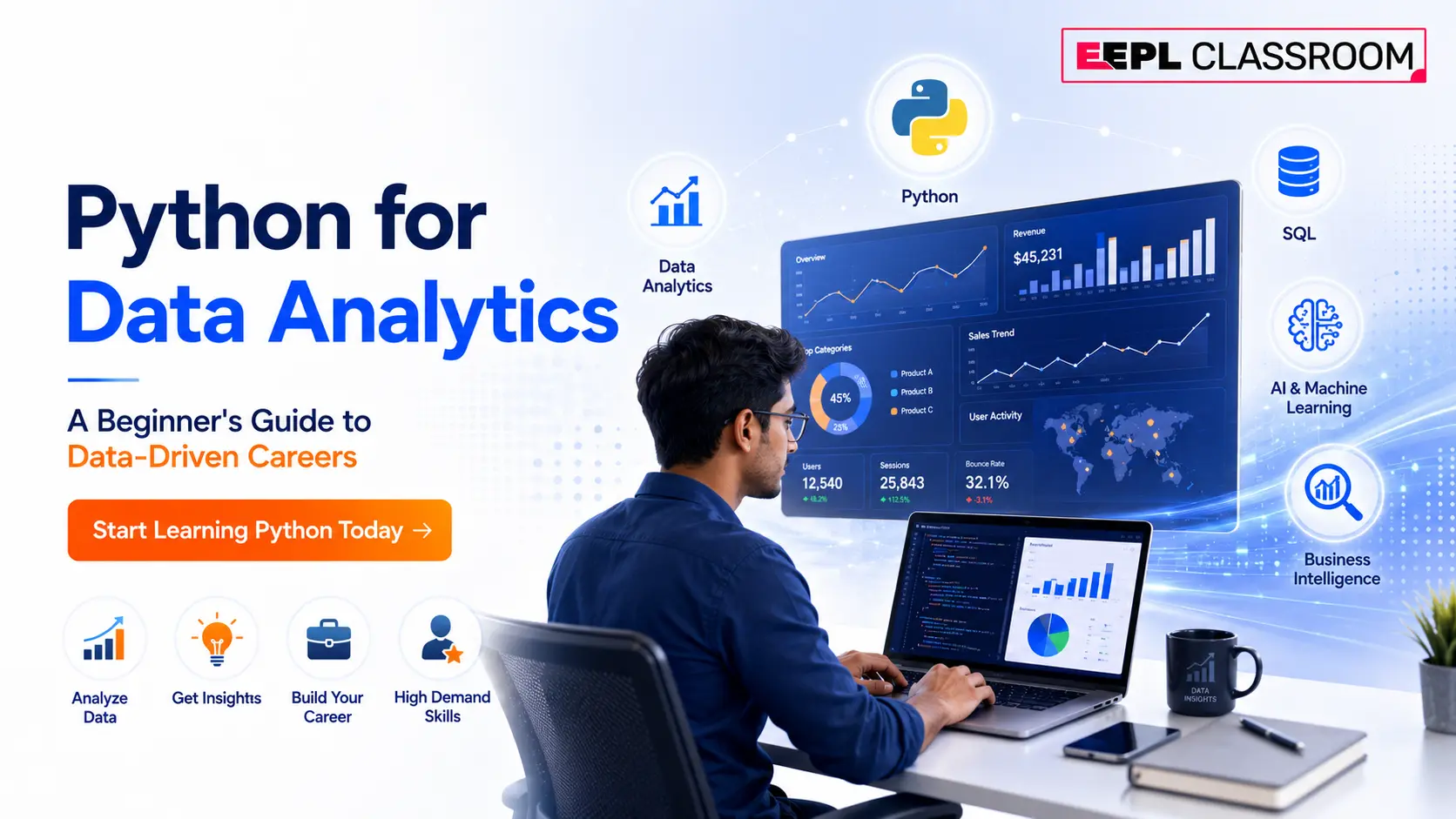
If you have been exploring careers in technology or data, you have almost certainly come across the phrase python for data analytics. It appears in job descriptions, course syllabi, YouTube tutorials, and career blogs and for very good reason. Python has become the single most important programming language in the world of data analysis, and its dominance is only growing. At EEPL Classroom, we work with hundreds of students every year who are beginning their journey into data analytics with Python, many of them with no prior coding experience. This guide is written specifically for them, and for anyone wondering how to start learning python for data analysis from scratch.
Why Is Python Popular for Data Analytics?
Before learning anything, it helps to understand why you are learning it. Python has not become the dominant language in data analytics by accident. There are specific, practical reasons why data professionals, companies, and training institutes worldwide recommend it above all alternatives.
Python is widely used in data analytics because it is:
Easy to learn: its syntax is clean and close to plain English, making it beginner-friendly
Versatile: it works for web development, automation, machine learning, and data analysis
Supported by powerful libraries: tools like Pandas, NumPy, Matplotlib, Seaborn, and Plotly make data work fast and efficient
In high demand across industries: banking, e-commerce, healthcare, logistics, and IT all use Python for data-driven decisions
Free and open-source: no licensing costs, with a massive global community
According to the Python Official Documentation, Python supports multiple programming paradigms and integrates seamlessly with data tools, databases, and cloud platforms making it the natural choice for python data analytics work.
Interested in building a career in Data Analytics using Python? Explore EEPL Classroom's structured training programmes in Ranchi and start learning with expert guidance.
Is Python Good for Data Analytics?
This is one of the most searched questions by beginners, and the answer is a clear yes. Python is not just good for data analytics, it is the preferred language for most data professionals worldwide.
The reason is simple. Data analytics involves collecting data, cleaning it, transforming it, analysing patterns, and presenting insights visually. Python has dedicated, industry-standard libraries for every one of these steps. No other language offers this combination of simplicity, power, and community support at the same level.
Even professionals who started their careers using tools like Excel or SPSS eventually transitioned to Python because of its ability to handle large datasets, automate repetitive tasks, and integrate with machine learning frameworks. For students and freshers exploring career options, learning python for data analytics is one of the highest-return investments they can make.
Key Python Libraries for Data Analytics
Understanding which libraries to focus on is one of the first questions every beginner asks. Here is a practical overview of the most important python libraries for data analytics.
Pandas
Pandas is the most important library for data analysis using Python. It provides data structures called DataFrames that allow you to load, clean, filter, sort, and manipulate structured data with ease. According to the Pandas Documentation, Pandas is built on top of NumPy and is designed specifically for working with labelled tabular data the kind you encounter in spreadsheets and databases every day.
If you only learn one Python library for data analytics, Pandas should be the first.
NumPy
NumPy stands for Numerical Python. It provides support for large multi-dimensional arrays and mathematical functions that operate on them efficiently. NumPy is the foundation on which most other data science libraries — including Pandas — are built. For anyone working with numerical data, statistical calculations, or scientific computing, NumPy is essential.
Matplotlib and Seaborn
Data analysis is only useful when insights can be communicated clearly. Matplotlib is Python's foundational data visualisation library, allowing users to create charts, graphs, histograms, and scatter plots. Seaborn builds on top of Matplotlib with more visually appealing, statistically-informed chart types. Together, these two libraries cover the majority of data visualisation needs for a working data analyst.
Plotly
Plotly takes visualisation a step further by enabling interactive charts and dashboards. It is widely used in business intelligence and reporting environments where stakeholders need to explore data visually. Plotly is increasingly requested in job descriptions for data analyst roles in India.
Scikit-learn
While primarily a machine learning library, Scikit-learn is also used extensively in data analytics for tasks such as regression, classification, clustering, and predictive modelling. Understanding the basics of Scikit-learn gives data analytics professionals the ability to move into machine learning roles as their career progresses.
Skills Needed for Data Analytics with Python
Learning Python libraries is only part of the picture. To become a job-ready data analyst, you also need a broader set of skills that complement your Python knowledge.
Data Wrangling and Cleaning
Real-world data is messy. It contains missing values, duplicates, formatting errors, and inconsistencies. Data wrangling the process of cleaning and organising raw data into a usable format is where most data analysts spend the majority of their time. Python, and specifically Pandas, makes this process manageable and efficient.
Exploratory Data Analysis (EDA)
Exploratory Data Analysis is the process of examining a dataset to understand its structure, identify patterns, spot anomalies, and form hypotheses before building models or drawing conclusions. EDA is a fundamental skill for any python data analytics professional, combining both statistical thinking and visualisation skills.
SQL and Database Knowledge
Most data that analysts work with lives in databases. Understanding SQL (Structured Query Language) alongside Python allows you to extract, filter, and join data from relational databases before bringing it into Python for further analysis. SQL and Python are used together in virtually every data analyst role in India today.
Statistical Thinking
Data analytics is rooted in statistics. Understanding concepts such as mean, median, standard deviation, correlation, probability distributions, and hypothesis testing is essential for interpreting data correctly. Python's NumPy and SciPy libraries make it straightforward to apply statistical methods to real datasets.
Data Visualisation and Storytelling
Technical analysis means nothing if the insights cannot be communicated clearly. Learning to create compelling charts, dashboards, and reports using Matplotlib, Seaborn, or Power BI and knowing how to explain findings to non-technical stakeholders — is a critical skill that separates good data analysts from great ones.
Python for Data Analytics: Beginner Roadmap
If you are just starting out, following a structured learning path will save you months of confusion. Here is the roadmap we recommend at EEPL Classroom for students beginning their python data analytics journey.
Step 1: Learn Python Basics
Start with core Python concepts: variables, data types, loops, functions, conditionals, and file handling. This foundation takes most beginners two to four weeks with consistent practice. Do not rush this stage — strong basics make everything that follows easier.
Step 2: Master Pandas and NumPy
Once you are comfortable with Python basics, move to Pandas and NumPy. Learn how to load CSV files, clean data, filter rows, group records, and perform basic calculations. Practice with real datasets — freely available on platforms like Kaggle.
Step 3: Learn Data Visualisation
Next, pick up Matplotlib and Seaborn. Learn how to create bar charts, line graphs, scatter plots, heatmaps, and box plots. Practice creating visualisations that tell a clear story from a dataset.
Step 4: Learn SQL Basics
Invest two to three weeks in learning SQL. Understand how to write SELECT queries, filter with WHERE clauses, join tables, and aggregate data with GROUP BY. This skill is almost universally required in data analyst job descriptions.
Step 5: Work on Real Projects
Begin building a portfolio by analysing real datasets. Choose topics that interest you — sports statistics, e-commerce sales, healthcare data, or financial trends. Documenting your projects on a platform like GitHub demonstrates your practical ability to employers.
Step 6: Explore Machine Learning Basics
Once you are confident in analytics, begin exploring Scikit-learn for introductory machine learning concepts. This step naturally transitions you from data analytics to a broader career in data science or machine learning.
Ready to follow this roadmap with expert mentorship? Join EEPL Classroom's Python Course in Ranchi and learn data analytics with Python through structured, hands-on training.
Why Python Is Used in Data Analytics Across Industries
Python in data analytics is not limited to the IT sector. It has become a cross-industry standard. Here is how different sectors use Python for data-driven decision making:
Banking and Finance: fraud detection, risk modelling, portfolio analysis
Healthcare: patient data analysis, clinical trial insights, hospital management
E-commerce and Retail: customer behaviour analysis, sales forecasting, inventory optimisation
Logistics and Supply Chain: route optimisation, demand prediction, delivery analysis
Marketing and Digital Media: campaign performance analysis, audience segmentation, ROI tracking
According to NASSCOM, data analytics professionals are among the most sought-after talent in India's technology industry, and Python is the core technical skill driving this demand. The ability to work with data using Python is no longer optional — it is a baseline expectation in most data-related roles.
Microsoft Learn also provides learning resources that reinforce Python's role in enterprise data environments, particularly in combination with Azure cloud services and Power BI for business intelligence workflows.
Learning Python for Data Analytics in Ranchi
For students and professionals based in Ranchi and Jharkhand, quality python training and data analytics training is available right here at EEPL Classroom. We are a trusted python training institute in Ranchi with a curriculum designed specifically to take complete beginners to job-ready competency.
Our python course in ranchi covers everything from core programming basics to advanced data analytics applications — including Pandas, NumPy, Matplotlib, Seaborn, and Exploratory Data Analysis. Our data analytics course in ranchi builds on the Python foundation and adds SQL, Power BI, and real-world capstone projects, giving students a complete, employable skill set.
We work with students from all backgrounds — science, commerce, arts — and our faculty is experienced in making technical concepts accessible regardless of prior background. Data analytics training in Ranchi at EEPL Classroom is structured to fit both freshers starting from zero and working professionals upgrading their existing skills.
Speak with our career counsellors at EEPL Classroom to understand which programme fits your goals Python, Data Analytics, or Machine Learning. Your data career can start today.
Frequently Asked Questions (FAQ) Python for Data Analytics:
Is Python good for data analytics?
Yes, Python is excellent for data analytics. It is the most widely used programming language in the field, supported by powerful libraries like Pandas, NumPy, and Matplotlib that make data work efficient and scalable.
Can beginners learn Python for data analytics?
Absolutely. Python is specifically recommended for beginners because of its clean, readable syntax. With the right structured learning path and guided practice, most beginners become productive in python data analytics within three to six months.
Which Python libraries are most important for data analytics?
The most important python libraries for data analytics are Pandas (data manipulation), NumPy (numerical computing), Matplotlib and Seaborn (visualisation), and Plotly (interactive charts). Scikit-learn is also valuable for introductory machine learning.
How long does it take to learn Python for data analytics?
With consistent practice and structured training, most beginners can develop job-ready python for data analysis skills in three to six months. The timeline varies based on prior experience and the depth of learning.
Why is Python used in data analytics instead of other languages?
Python is preferred because it is beginner-friendly, has a rich ecosystem of data libraries, integrates easily with databases and cloud tools, and is backed by one of the largest programming communities in the world. It handles everything from simple data cleaning to complex machine learning.
What jobs can I get after learning Python for data analytics?
After learning data analytics with Python, you can apply for roles such as Data Analyst, Business Analyst, Data Engineer, Reporting Analyst, MIS Analyst, or Junior Data Scientist across industries including IT, banking, retail, and healthcare.
Do I need a mathematics background to learn Python for data analytics?
Not necessarily. While a basic understanding of statistics and mathematics is helpful, many students without a strong maths background have successfully learned python data analytics through structured training. The key is learning statistical concepts alongside Python in a practical context.
Is Python enough for a data analytics career, or do I need other tools too?
Python is the core skill, but a complete data analyst profile also includes SQL, Excel, and a visualisation tool like Power BI or Tableau. At EEPL Classroom, our data analytics training covers all of these together.
Can I learn Python for data analytics in Ranchi?
Yes. EEPL Classroom offers structured python training and data analytics courses in ranchi for students at all levels, with hands-on projects, experienced faculty, and placement-focused guidance.
Conclusion
Python for data analytics is not a passing trend, it is the foundation of one of the fastest growing career fields in India and the world. Whether you are a student exploring your first career path, a fresher looking for a high-value skill, or a working professional planning a switch into data, Python is the most powerful starting point available to you today.
At EEPL Classroom, we believe that every student in Ranchi and Jharkhand deserves access to quality, career-focused training that actually leads to employment. Our Python and Data Analytics programmes are built on that belief practical, updated, mentor-led, and designed for real outcomes. Start your python data analytics journey with the right support, and the career you want becomes far more reachable than you think.