DCA vs ADCA vs Data Analytics Course: Which Should You Take First?
Confused about whether to start with DCA, ADCA, or a data analytics course? EEPL Classroom breaks down the right sequence based on your background and goals.
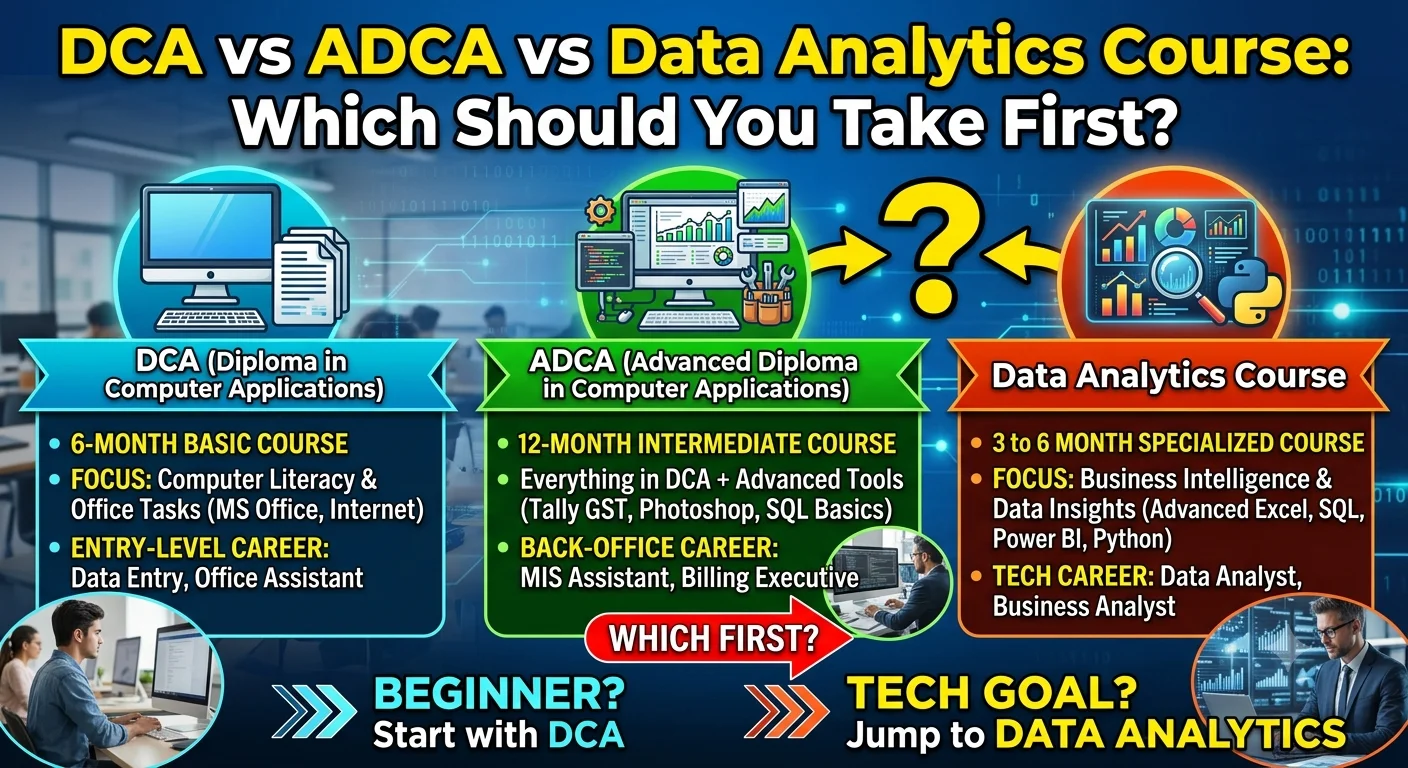
At EEPL Classroom, one of the most frequent questions we hear from students walking into our institute is a simple one: should I start with our DCA Course in Ranchi, move on to ADCA, or jump straight into a specialised data analytics programme? It's a fair question, and the honest answer depends entirely on your current computer literacy, your career goals, and how much time you have available. This guide, based on what we've seen work for hundreds of students at our institute, breaks down exactly how DCA vs ADCA vs Data Analytics Course compare, and which sequence makes sense for your situation.
What Is DCA (Diploma in Computer Applications)?
DCA is designed as a foundational computer literacy programme. It's typically the first formal computer course a student takes, especially if they're coming from a school background with limited hands-on computer exposure.
At EEPL Classroom, our DCA Course in Ranchi covers:
Basic computer operations and Windows fundamentals
MS Office (Word, Excel, PowerPoint) at a beginner level
Internet basics, email, and typing skills
Introduction to basic accounting or DTP modules, depending on the batch
DCA is not designed to make you job-ready for a technical or analytical role on its own. It's meant to build comfort and confidence with computers — the kind of baseline literacy that almost every other course, including a data analytics programme, assumes you already have.
What Is ADCA (Advanced Diploma in Computer Applications)?
ADCA builds on top of DCA and goes noticeably deeper into practical, employable skills. Students who complete our ADCA Course in Ranchi are generally aiming for entry-level office jobs, data entry roles, or further specialisation.
ADCA typically includes:
Advanced MS Office, including Excel formulas and formatting
Tally and basic accounting software
Internet applications and basic web tools
An introduction to programming logic in some batches
Where DCA builds comfort, ADCA builds employability at a basic office-skills level. It's a natural next step for students who've completed DCA and want a more complete, job-ready skill set before deciding on a specialised career path.
What Does a Data Analytics Course Actually Teach?
A data analytics programme is a different category of training altogether. It's not a general computer literacy course, it's a specialised, career-track programme aimed at a specific job outcome: becoming a Data Analyst or moving into business analytics roles.
Our Data Analytics Course in Ranchi covers:
SQL for querying and managing data
Python (Pandas, NumPy) for data manipulation and analysis
Power BI and Tableau for building dashboards
Statistics fundamentals for interpreting data correctly
Real capstone projects across industries like finance, e-commerce, and healthcare
This course assumes a certain baseline computer comfort already exists which is exactly why the sequencing question, DCA vs ADCA vs data analytics, matters so much for students starting from scratch.
DCA vs ADCA vs Data Analytics Course: The Core Difference
Here's the simplest way to think about it. DCA teaches you to use a computer confidently. ADCA teaches you to use a computer productively in an office setting. A data analytics course teaches you to extract insights and make data-driven decisions using specialised technical tools.
They're not competing options — they sit at different points on a skill-building ladder, and the right starting point depends entirely on where you currently stand.
Which Course Should You Take First?
This depends on your background, and at EEPL Classroom, we typically guide students using the following logic.
If You're a Complete Beginner with Computers
Start with DCA. If you're not yet comfortable typing, navigating Windows, or using MS Office independently, jumping straight into a data analytics course will feel overwhelming, since tools like Excel and SQL assume you already have this baseline.
If You're Comfortable with Basic Computer Use but Want Office-Ready Skills
Start with ADCA. If you already know basic MS Office and internet use but want stronger, more employable office skills — particularly Excel and Tally — ADCA gives you a solid foundation before specialising further.
If You Already Have Strong Computer and Excel Skills
Go straight to our Data Analytics Course in Ranchi. Many of our students — particularly BCA, B.Sc, B.Com, and B.Tech graduates, along with working professionals — already have the computer literacy DCA and ADCA are designed to build. For these students, starting with data analytics directly is the right call, since repeating foundational computer training would be a waste of time.
Can You Take a Data Analytics Course After Completing DCA or ADCA?
Yes, and this is actually one of the most common and successful paths we see at EEPL Classroom. Students who complete our DCA Course in Ranchi or ADCA Course in Ranchi are well-positioned to move into data analytics as a natural next step, since they've already built the computer confidence and basic Excel familiarity that a data analytics programme builds on.
This progression works particularly well for:
Students who started with limited computer exposure and built up gradually
Career switchers from non-IT backgrounds easing into technical training step by step
Job seekers who want a broader, layered skill set rather than a single narrow qualification
Who Should Skip Straight to a Data Analytics Course?
Not everyone needs to start from DCA. If any of the following describes you, going directly into our Data Analytics Course in Ranchi makes more sense:
You're a college graduate already comfortable with MS Office and basic computer use
You're a working professional in finance, marketing, or operations wanting to upskill specifically in data analysis
You're a fresher from a technical background (BCA, B.Tech, B.Sc) with existing computer familiarity
You're short on time and need to reach a specific job outcome, like a Data Analyst role, without extra detours
Skipping DCA and ADCA isn't a shortcut in a negative sense, it's simply recognising that these foundational programmes exist to build skills you may already have.
Time and Career Investment Comparison
Here's a general sense of how these three programmes compare in terms of duration and typical outcome, based on our experience running all three at EEPL Classroom.
DCA usually takes a few months and builds general computer literacy, suited for absolute beginners with no clear specialisation yet in mind.
ADCA takes somewhat longer and adds office-ready skills like Tally and advanced Excel, suited for students aiming at entry-level office or data-entry roles.
Data Analytics Course typically runs 3 to 6 months and is specifically career-track training aimed at Data Analyst and Business Analyst roles, with a clearer and more direct path to higher-paying, specialised employment.
A Simple Decision Framework
Before choosing between DCA, ADCA, or a data analytics course, ask yourself these questions:
Can I already use MS Office and the internet comfortably without help? If not, start with DCA.
Do I want office-ready skills like Tally and advanced Excel before specialising? If yes, consider ADCA next.
Am I aiming specifically for a Data Analyst or Business Analyst role? If yes, and your computer basics are solid, go directly to our Data Analytics Course.
Am I a working professional or graduate with existing computer comfort? If yes, skipping straight to data analytics is usually the more efficient path.
Why This Sequencing Matters for Parents and Students Planning Ahead
For parents evaluating options for their children, and for students planning their own learning path, understanding this sequencing helps avoid two common mistakes: enrolling in a data analytics course before basic computer comfort is in place, which leads to frustration, or unnecessarily repeating foundational training that a student has already outgrown, which wastes time and money.
At EEPL Classroom, we take the time to understand a student's current skill level before recommending a starting point, rather than pushing everyone toward the same course. You can also speak with our Career Counselling in Ranchi team if you're unsure where you currently stand.
Frequently Asked Questions
Should I do DCA before a data analytics course?
Only if you're not yet comfortable with basic computer use and MS Office. If you already have this foundation, you can go directly into a data analytics course without needing DCA first.
Is ADCA necessary before learning data analytics?
Not necessarily. ADCA is useful if you want broader office-ready skills like Tally and advanced Excel, but it isn't a mandatory prerequisite for a data analytics course if your computer basics are already strong.
Can I join a data analytics course directly without DCA or ADCA?
Yes. Many of our students, particularly college graduates and working professionals, join our Data Analytics Course in Ranchi directly, since they already have the computer literacy these foundational courses are designed to build.
What is the difference between DCA and ADCA?
DCA focuses on basic computer literacy and MS Office fundamentals, while ADCA goes further into employable office skills like advanced Excel and Tally, generally aimed at entry-level office roles.
Which is better for a career in data analytics — DCA, ADCA, or a direct data analytics course?
For a specific career in data analytics, a dedicated data analytics course itself is the most direct path. DCA and ADCA are useful stepping stones only if your computer fundamentals aren't yet strong enough to start data analytics comfortably.
How long does it take to complete DCA, ADCA, and a data analytics course together?
Combined, this path can take anywhere from 8 months to a year, depending on batch pace, though many students with existing computer skills skip DCA and ADCA and complete just the data analytics course in 3 to 6 months.
Does EEPL Classroom offer all three courses — DCA, ADCA, and data analytics?
Yes. EEPL Classroom offers a DCA Course in Ranchi, an ADCA Course in Ranchi, and a dedicated Data Analytics Course in Ranchi, allowing students to choose the right starting point or progress through all three as needed.
Whether you're starting from complete scratch or already have a strong computer foundation, the right sequence isn't about following a fixed path — it's about honestly assessing where you currently stand and choosing the course that gets you to your career goal without unnecessary detours.
For More Information and Updates
Phone Number: 7488713536
Email ID: eeplclassroom1@gmail.com
Blogs: EEPL Classroom Blogs
Our Platforms
Follow Us on Social Media