Data Structures & Algorithms Course in Ranchi | Start Now
Learn Data Structures and Algorithms in Ranchi with practical coding training at EEPL Classroom. Build problem-solving skills and strengthen your programming foundation.
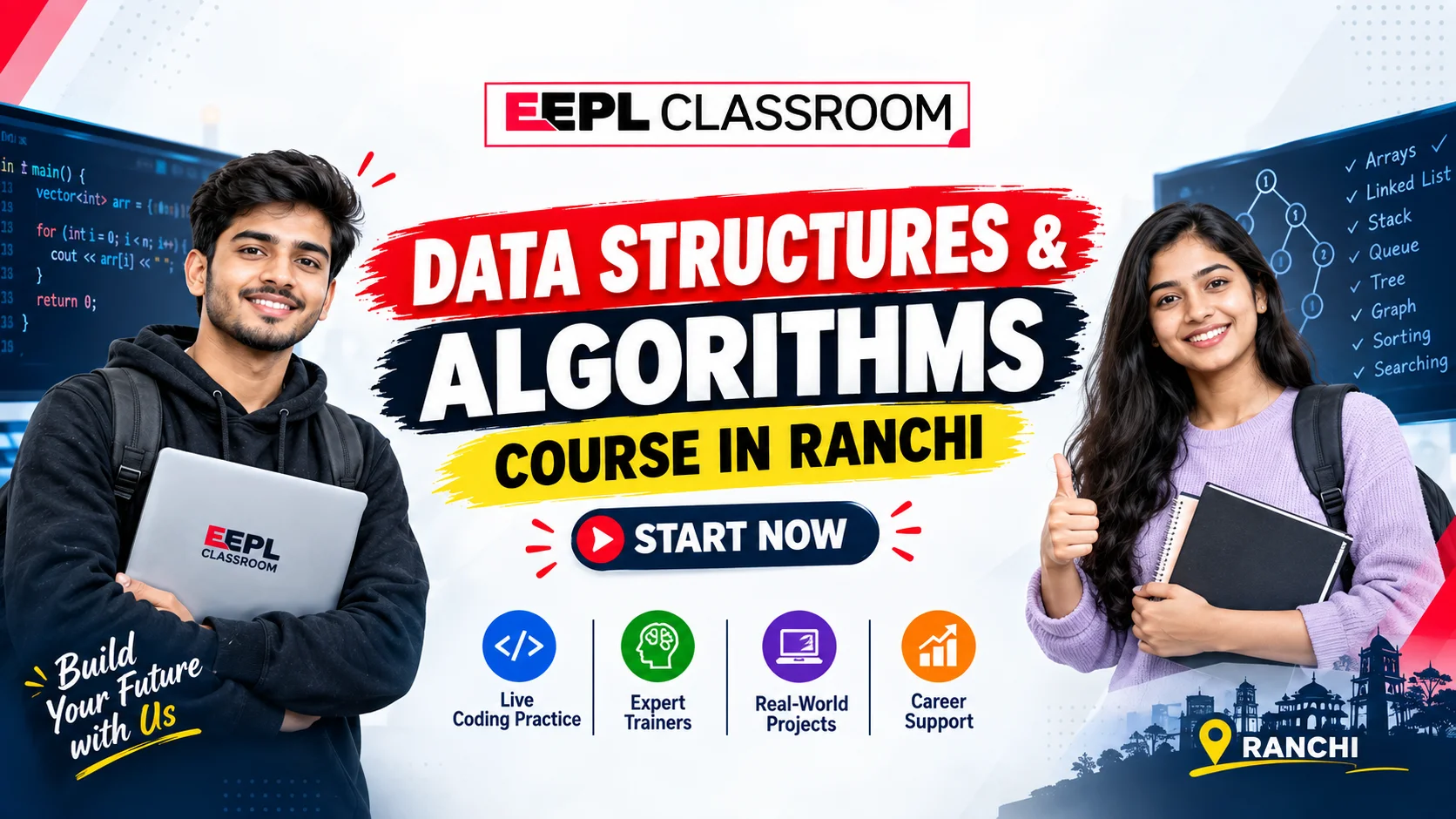
In today’s technology-driven career landscape, learning programming is not limited to memorizing coding syntax. A good programmer also needs to understand how to solve problems efficiently, which data structure to use, and how the performance of an algorithm can be improved. This is why Data Structures and Algorithms (DSA) has become an important programming skill for students.
If you are looking to learn DSA in Ranchi, the DSA Course in Ranchi at EEPL Classroom provides practical training in data structures, algorithms, coding practice, and problem-solving skills. The course is designed for students, graduates, beginners, BCA/B.Tech students, and aspiring software developers.
What is DSA and Why is it Important for Students?
DSA stands for Data Structures and Algorithms.
A Data Structure is a way of organizing and storing data so that it can be accessed and managed efficiently. An Algorithm, on the other hand, is a step-by-step approach used to solve a particular problem.
For example, if you have thousands of records and need to quickly find a specific record, choosing the right data structure and algorithm can significantly affect the efficiency of your program.
Learning DSA can help students:
- Improve logical thinking
- Strengthen programming fundamentals
- Learn how to break complex problems into smaller steps
- Develop an understanding of efficient coding
- Prepare for coding tests and technical interviews
For this reason, DSA is a useful technical skill for computer science students and aspiring developers.
What Will You Learn in a DSA Course in Ranchi?
The Diploma in Data Structure and Algorithms at EEPL Classroom focuses on practical learning and problem-solving. The course covers important DSA concepts, from fundamentals to advanced topics.
Arrays and Strings
Students begin with basic data structures such as arrays and strings. They learn how to store, access, update, and perform different operations on data.
Linked List
Linked Lists use nodes and pointers or references to organize data. Students learn important operations such as insertion, deletion, and traversal through coding practice.
Stack and Queue
Stack and Queue are commonly used data structures in programming. Students learn their working principles, operations, and practical applications through examples and coding exercises.
Searching and Sorting Algorithms
Searching and sorting are important parts of DSA. Students learn different approaches to search and arrange data while understanding the efficiency of different algorithms.
Trees and Binary Trees
Tree data structures are useful for representing hierarchical information. The course covers concepts such as trees, binary trees, and binary search trees.
Graphs and Graph Traversal
Graphs are used to represent relationships and connections between different elements. Students learn graph concepts and traversal techniques through practical problems.
Recursion, Hashing, and Advanced Algorithms
The course also covers recursion, hashing, heaps, greedy algorithms, and dynamic programming. These topics help students develop a better understanding of how to approach complex programming problems.
Why Should You Learn Time Complexity and Big O Notation?
Knowing that a program produces the correct output is not enough. It is also important to understand how efficiently the program works.
That is why Time Complexity, Space Complexity, and Big O Notation are important parts of DSA.
Students learn how to analyze the execution time and memory usage of algorithms. This helps them compare different solutions, understand efficiency, and choose a suitable approach for solving a problem.
How Does EEPL Classroom Help with the Diploma in Data Structure and Algorithms?
EEPL Classroom in Ranchi provides practical, classroom-based training for students learning DSA. The course focuses not only on theoretical concepts but also on coding practice and problem-solving exercises.
1. Practical Classroom Training
Students learn DSA concepts in a classroom environment and understand them through coding examples. This step-by-step approach can make difficult DSA topics easier to understand, especially for beginners.
2. Regular Coding Practice
DSA cannot be learned effectively through theory alone. Regular coding practice is important for developing problem-solving skills. The course provides coding exercises and assignments that allow students to practice the concepts they learn.
3. Problem-Solving Approach
The course focuses not only on writing code but also on analyzing problems and developing efficient solutions. Students learn how to understand a problem, create an approach, write code, and improve their solutions.
4. Doubt-Solving Support
While learning topics such as recursion, trees, graphs, and dynamic programming, students may have questions or face difficulties. Doubt-solving support helps students clarify concepts and improve their understanding.
5. Interview and Coding Preparation
DSA is also useful for technical interviews and coding assessments. The course includes coding practice and interview-oriented problems, helping students develop their technical problem-solving skills.
Who Can Join a DSA Course in Ranchi?
The course can be useful for students and learners from different educational backgrounds, including:
- BCA and B.Tech students
- Computer Science students
- College students
- Programming beginners
- Graduates
- Aspiring software developers
- Students preparing for coding interviews
- Learners preparing for technical placements
- BA, MA, and students from other backgrounds who want to learn programming and DSA
If you already know programming but find it difficult to solve complex problems, learning DSA can help strengthen your problem-solving foundation.
EEPL Classroom DSA Course Duration and Mode
According to the current course information, the DSA training at EEPL Classroom is designed for approximately 45–60 days and is available in offline classroom mode.
The course includes practical training, coding practice, assignments, problem-solving exercises, interview preparation, doubt-solving support, and career guidance.
This gives students an opportunity to learn DSA concepts through classroom instruction and practical coding rather than relying only on theoretical study material.
What Can Students Do After Learning DSA?
DSA can help strengthen a student's programming foundation and provide a useful base for learning other software development skills.
After developing DSA knowledge, students can continue building their skills in areas such as software development, programming, and technical interview preparation. Potential career directions may include roles such as Software Developer, Software Engineer, Junior Developer, Application Developer, Backend Developer, and Programmer.
However, completing a DSA course alone does not guarantee a particular job. Career opportunities also depend on programming skills, projects, communication skills, interview preparation, and other technical abilities.
Why Consider a DSA Course in Ranchi?
If you are based in Ranchi and find it difficult to maintain consistency, clear doubts, or practice coding while learning DSA through online videos, offline classroom training can provide a structured learning environment.
The DSA program at EEPL Classroom supports students through structured learning, classroom training, coding exercises, and problem-solving practice.
For students who want to build a strong foundation in programming and understand how data structures and algorithms work in real coding problems, structured DSA training can be a useful learning step.
Conclusion
A DSA Course in Ranchi can be a useful learning option for students who want to strengthen their programming fundamentals and develop a practical understanding of data structures and algorithms.
The Diploma in Data Structure andAlgorithms at EEPL Classroom covers important topics such as arrays, strings, linked lists, stacks, queues, trees, graphs, recursion, searching, sorting, hashing, dynamic programming, time complexity, and Big O notation.
If your goal is to build a strong programming foundation, improve your ability to solve coding problems, and start preparing for technical interviews, DSA can become an important part of your learning journey.
Through offline DSA training in Ranchi, EEPL Classroom provides students with a structured environment to understand concepts, practice coding, and develop problem-solving skills.
For More Information and Updates
Phone Number: 7488713536
Email ID: eeplclassroom1@gmail.com
Blogs: EEPL Classroom Blogs