Data Analytics Course in Ranchi vs Online Courses: Which Should You Choose?
Comparing an offline Data Analytics Course in Ranchi with online alternatives? Here's an honest breakdown to help you choose the right training near you.
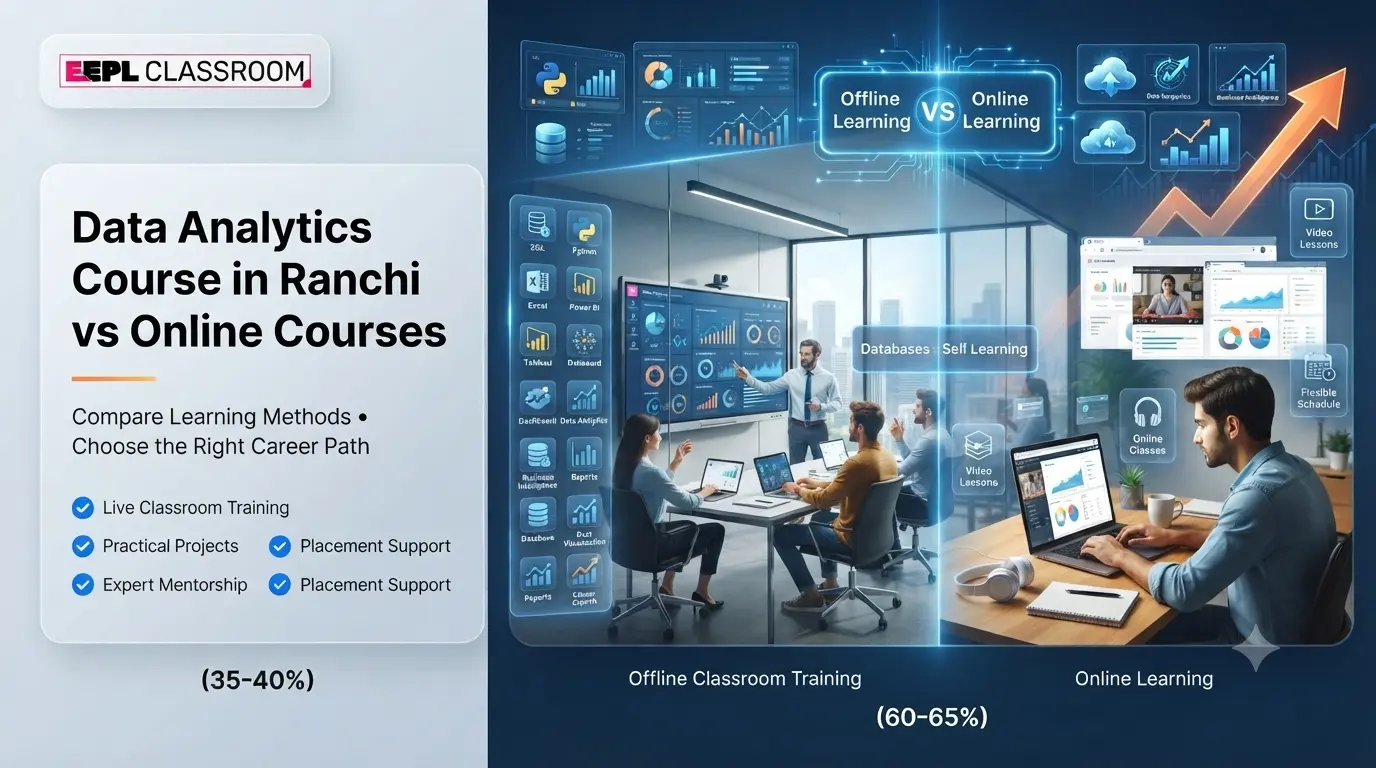
If you've typed "data analytics course near me" into Google recently, you've probably been hit with two very different types of results — local institutes offering classroom-based training, and a long list of online platforms promising the same skills from your laptop. Both paths can genuinely teach you data analytics. But they are not interchangeable experiences, and the right choice depends heavily on how you learn, what support you need, and what you're optimising for.
At EEPL Classroom, we run an offline data analytics course in Ranchi, and we get this question constantly from students comparing us against online options. This article isn't here to tell you online learning doesn't work — it does, for the right kind of learner. It's here to help you honestly evaluate which format actually fits you.
Why This Comparison Matters More Than It Seems
Data analytics itself isn't a soft skill you can half-learn and still succeed with. Employers expect real command over SQL, Python, Excel, and dashboarding tools like Power BI — not just certificate completion. So the format you learn in directly affects how job-ready you actually are at the end, not just how convenient the learning process feels along the way.
This is why "near me" searches for data analytics training have grown steadily — students are increasingly looking for local, offline, mentor-led options specifically because they've either tried a self-paced course before, or heard from someone who has, and want a different experience this time.
How Offline Training in Ranchi Actually Works
At EEPL Classroom, our data analytics course in Ranchi runs as a structured, in-person classroom programme, with instructors physically present, real-time doubt resolution, and small batch sizes. A typical session includes:
Live instruction on tools like Excel, SQL, and Python
Immediate doubt-clearing during the session, not through a support ticket
Hands-on practice with real datasets under instructor supervision
Peer learning — working alongside classmates facing the same concepts
Direct access to faculty outside class hours for extra help
This format is deliberately built around accountability. When you're expected to show up to a physical classroom, complete assignments before the next session, and explain your work to an instructor face-to-face, the learning pace is enforced externally rather than left entirely to self-discipline.
How Online Data Analytics Courses Typically Work
Online platforms — whether large MOOCs or subscription-based learning apps — usually offer:
Pre-recorded video lectures you watch at your own pace
Discussion forums or community channels for questions
Auto-graded quizzes and assignments
Certificates upon completion of modules
Flexibility to learn anytime, anywhere, often at a lower price point
This format genuinely works well for a specific type of learner — someone who is highly self-motivated, already has some baseline familiarity with the subject, and doesn't need external structure to stay consistent. If that's you, an online course can be a perfectly reasonable way to pick up new tools.
Where Offline Training Has a Real Edge
1. Doubt resolution happens in real time.
When you're stuck on a SQL query or a Python error at 8 PM during an online course, you're often waiting hours (or days) for a forum reply. In our classroom, that same doubt gets resolved on the spot, which keeps momentum going instead of stalling progress.
2. Accountability is built-in, not optional.
Online courses have notoriously low completion rates precisely because there's no external structure forcing you to show up. A classroom environment — with fixed batch timings and instructor expectations — naturally keeps students on pace.
3. Feedback on your actual work, not just automated grading.
Capstone projects and dashboards need human judgment to evaluate properly — did you interpret the data correctly, did you choose the right chart type, does your analysis actually answer the business question. Automated quiz grading can't replicate that kind of feedback.
4. Placement support is local and personal.
At EEPL Classroom, our placement assistance includes resume reviews, mock interviews, and direct connections to hiring partners in Ranchi and across India — built on relationships, not just a generic job board link inside a course dashboard.
5. Peer learning changes how you retain concepts.
Explaining a concept to a classmate, or watching how someone else approached the same dataset differently, reinforces learning in ways that solitary video-watching simply doesn't replicate.
Where Online Courses Genuinely Make Sense
To be fair, online learning isn't without real advantages:
Lower cost, in most cases, since there's no physical infrastructure to maintain
Flexibility for people in remote locations who don't have access to a quality institute nearby
Self-paced learning for people with unpredictable schedules
Wide course catalog variety, letting you sample multiple platforms before committing
If you already work in a data-adjacent role, are simply upskilling on one specific tool (say, just Power BI), and are confident in your ability to self-discipline through a course without external accountability, an online option can absolutely work.
The "Near Me" Factor — Why Location Still Matters
Here's something that gets overlooked in the online-vs-offline debate: local training isn't just about convenience, it's about context. An institute based in Ranchi understands the local job market, has relationships with regional employers, and can guide you on what specific skills local companies are actually hiring for — something a generic global online course simply cannot personalise.
This is exactly why searches like "data analytics course near me" and "data analyst course in ranchi offline" continue to grow — students want training that's not just technically sound, but locally relevant to where they plan to build their career.
A Simple Framework to Decide
Ask yourself these questions before choosing:
Do I need external accountability to stay consistent? If yes, lean offline.
Do I learn better by asking questions in real time, or am I comfortable troubleshooting alone? If you prefer real-time help, lean offline.
Am I completely new to data analytics, or already have foundational knowledge? Complete beginners generally benefit more from structured, offline guidance.
Do I want local job market guidance and placement support? If job placement in your city matters, offline institutes typically offer more personalised support.
Is my schedule too unpredictable for fixed batch timings? If so, and you're highly self-motivated, online may suit you better.
Why EEPL Classroom Built an Offline-First Model
We deliberately chose to build our data analytics course in Ranchi as a classroom-based programme, not because online learning doesn't work, but because we've seen firsthand how much faster and more confidently students progress when they have real-time mentorship, peer accountability, and hands-on guided practice — especially when tackling tools like SQL and Python for the first time.
Our small batch sizes, flexible morning/evening/weekend timings, and direct faculty access outside class hours are built specifically to close the gaps that online courses often leave open — without sacrificing the flexibility working professionals and students genuinely need.
Frequently Asked Questions About Data Analytics Course in RANCHI VS oNLINE Courses
Is an offline data analytics course better than an online one?
It depends on your learning style. Offline courses generally offer stronger accountability, real-time doubt resolution, and personalised placement support, while online courses offer more flexibility and often lower cost.
Why are more people searching for "data analytics course near me" instead of online courses?
Many students have tried self-paced learning before and found it hard to stay consistent without structure, real-time support, or local job market guidance — pushing them toward local, offline options instead.
Does EEPL Classroom offer only offline batches?
Yes, our Data Analytics Course in Ranchi is conducted in offline, classroom-based mode, with flexible morning, evening, and weekend batch timings.
Can I switch from an online course to an offline one midway through my learning?
Yes. Many students who start online, especially without structured mentorship, later join offline institutes like EEPL Classroom to fill gaps in practical application and gain real-time guidance.
Is offline training more expensive than online courses?
It can be slightly higher due to infrastructure and personalised mentorship, but EEPL Classroom keeps its offline data analytics training affordably priced, with flexible payment options for students and working professionals.
Which format offers better placement support — online or offline?
Offline institutes typically offer more personalised, locally-relevant placement support, including mock interviews, resume reviews, and direct employer connections, compared to generic online course placement portals.
If you're weighing an offline data analytics course in Ranchi against an online alternative, the right choice ultimately comes down to how you learn best and if real-time mentorship, accountability, and local placement support matter to you, our classroom-based programme is built exactly for that.