Data Analytics Career Roadmap: A Step-by-Step Guide for Beginners
Follow our complete data analytics career roadmap to become a data analyst from scratch. Learn skills, tools, projects, and how to land your first data analytics job in India.
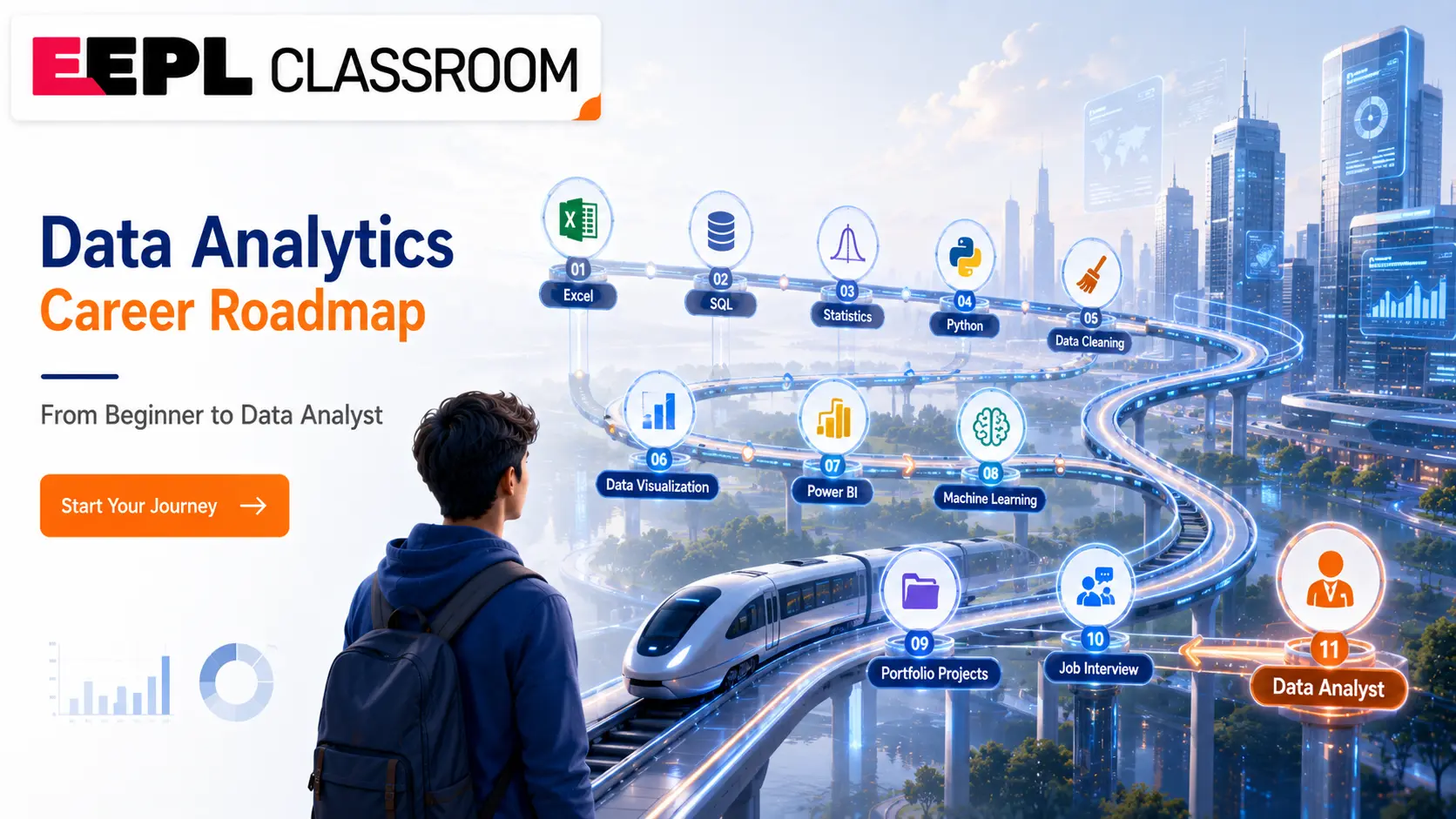
If you have been wondering how to become a data analyst but do not know where to begin, you are in the right place. The data analytics career roadmap is one of the most searched guides by students, freshers, and working professionals in India today and rightly so. Data analytics has emerged as one of the most in-demand career paths across industries, from banking and healthcare to e-commerce and government. At EEPL Classroom, we have helped hundreds of students in Ranchi and Jharkhand build structured, job-ready skills in data analytics, and this guide reflects exactly what we teach and recommend.
This is not a generic list of tips. This is a step-by-step data analytics roadmap built for real beginners, whether you are a student after Class 12, a college graduate, or a professional looking to switch careers.
Why Choose a Data Analytics Career in 2026?
Before diving into the roadmap, it is worth understanding why data analytics as a career is worth pursuing right now.
Every business today generates massive volumes of data — from customer transactions and website visits to supply chain logs and social media activity. But data alone is useless without someone to interpret it and convert it into decisions. That is exactly what a data analyst does.
According to NASSCOM, India's data and analytics market is projected to grow significantly through the latter half of this decade, with demand for skilled data analysts and data scientists outpacing supply. The World Economic Forum has consistently listed data analysis among the top ten fastest-growing job roles globally. In simple terms: if you build the right skills, jobs will find you.
Data analyst salary in India ranges from ₹3.5–7 LPA at entry level, ₹8–15 LPA at mid-level, and ₹18–35 LPA or more for senior roles and data scientists — making it one of the most financially rewarding career paths for students and graduates in India.
Who Is This Data Analytics Career Roadmap For?
This data analytics roadmap for beginners is designed for:
Students in Class 11, 12, BCA, B.Sc, B.Com, or B.Tech who want to build a career in data
Freshers and recent graduates preparing for their first analytics job
Working professionals from non-tech backgrounds looking to switch into data roles
Parents exploring future-proof career options for their children
Anyone who wants to become a data analyst without a prior coding background
You do not need to be a mathematics genius or a programming expert. What you need is a structured data analyst learning path, the right tools, and consistent practice — all of which this guide covers.
Complete Data Analytics Career Roadmap — Step by Step
Step 1: Understand What a Data Analyst Actually Does
Before you start learning tools and languages, understand the role clearly. A data analyst collects, processes, and interprets structured data to help organisations make informed decisions. Day-to-day tasks include:
Cleaning and organising raw datasets
Performing exploratory data analysis (EDA)
Building dashboards and visualisations
Identifying trends, patterns, and anomalies
Presenting findings to business stakeholders in simple language
Understanding the job profile first helps you stay motivated and focused throughout the data analytics learning roadmap.
Step 2: Build Your Mathematics and Statistics Foundation
Data analytics is built on a foundation of numbers. You do not need advanced university-level mathematics, but you do need a solid working understanding of:
Descriptive Statistics — Mean, median, mode, variance, standard deviation
Probability basics — Understanding distributions and likelihood
Correlation and regression — Understanding relationships between variables
Hypothesis testing — Drawing valid conclusions from data
If you are a student who studied Mathematics in Class 12, you already have a significant head start. For others, free resources and structured classroom training can bring you up to speed relatively quickly.
Step 3: Learn Microsoft Excel and Google Sheets
Microsoft Excel is the most widely used data tool in the world, and it remains a core data analyst skill even in 2025. Many organisations — especially small and mid-sized businesses — rely on Excel for reporting, budgeting, and analysis.
Key Excel skills to master:
VLOOKUP, HLOOKUP, XLOOKUP — Data matching and lookup
Pivot Tables — Summarising large datasets quickly
Conditional Formatting — Visual pattern identification
Data Validation and Charts — Clean input and clear output
Power Query — Automating data import and transformation
Excel is your starting point on the data analyst roadmap — quick to learn, universally valued, and essential for the first job.
Step 4: Learn SQL for Data Querying
SQL (Structured Query Language) is the language that speaks directly to databases, and it is arguably the single most important technical skill for a data analyst. Almost every data analytics role in India and globally requires SQL proficiency.
According to the official SQL documentation and W3Schools SQL reference, SQL enables analysts to extract, filter, sort, and aggregate data from relational databases — the backbone of most enterprise data systems.
Core SQL concepts to learn:
SELECT, WHERE, GROUP BY, ORDER BY — Basic querying
JOINs — Combining data from multiple tables
Aggregate Functions — COUNT, SUM, AVG, MAX, MIN
Subqueries and CTEs — Advanced data extraction
Window Functions — Ranking and running totals
Practice SQL on platforms like Mode Analytics, LeetCode (SQL section), or HackerRank's SQL challenges. Even 30 minutes of daily SQL practice over two months will take you to a job-ready level.
Step 5: Learn Python for Data Analytics
Python is the most powerful and versatile tool in a data analyst's arsenal. While SQL retrieves data, Python processes, analyses, and visualises it at scale. It is also the gateway to machine learning and advanced analytics.
The Python Official Documentation is a strong starting point, but structured classroom training dramatically accelerates learning for beginners. Key Python libraries for data analytics include:
NumPy — Numerical computing and array operations
Pandas — Data manipulation and cleaning
Matplotlib and Seaborn — Data visualisation
Scikit-learn — Basic machine learning models
Jupyter Notebook — Interactive code and analysis environment
A Python Course in Ranchi at EEPL Classroom provides structured, mentor-led training covering all these libraries with hands-on project work ensuring you go beyond syntax memorisation into real analytical thinking.
Step 6: Master Data Visualisation Tools
Data visualisation is the bridge between raw analysis and business decision-making. Even the most powerful analysis is wasted if it cannot be communicated clearly. This is where tools like Power BI and Tableau come in.
Key data visualisation skills for analysts:
Building interactive dashboards in Power BI or Tableau
Using charts appropriately — bar, line, pie, scatter, heatmap
Designing for clarity and business storytelling
Connecting visualisation tools to live data sources
Microsoft Learn offers a free, structured Power BI learning path that covers fundamentals through publishing and sharing reports. Learning Power BI alongside Python significantly strengthens your data analyst skill set and makes your portfolio stand out.
Step 7: Understand Data Cleaning and Data Wrangling
In the real world, data is messy. Surveys with blank fields, sales records with duplicate entries, date formats that differ across columns — this is the norm, not the exception. Data cleaning (also called data wrangling) is the process of preparing raw data for analysis, and it occupies 60–80% of a real data analyst's working time.
Skills in this area include:
Handling missing values and null entries
Removing duplicates and correcting formatting errors
Standardising data types and column structures
Merging datasets from multiple sources
Mastering data cleaning using Pandas in Python is one of the most practically valuable steps on the data analytics learning roadmap. It is unglamorous work, but it separates average analysts from exceptional ones.
Step 8: Build Real Projects and a Portfolio
Theory without application is incomplete. Building a data analytics portfolio with real projects is what converts learning into employment. Employers in India and globally look for demonstrated ability, not just certificates.
Beginner-friendly project ideas:
Sales Analysis Dashboard: Analyse e-commerce or retail sales data with Power BI
COVID-19 Data Exploration: Use Python and Pandas to explore publicly available health data
Customer Churn Prediction: A basic ML model using Scikit-learn
IPL or Cricket Statistics Analysis: Engaging, India-specific dataset with strong visual storytelling potential
Finance Budget Tracker: Excel-based dashboard with advanced formulas and charts
Upload your projects to GitHub and document them clearly. A well-organised GitHub profile is one of the strongest signals of competence for analytics hiring managers.
CTA 1: Begin Your Data Analytics Journey at EEPL Classroom
Building these skills alone can feel overwhelming without guidance. EEPL Classroom's Data Analytics Course in Ranchi covers Excel, SQL, Python, and Power BI in a structured, mentor-led format — with real project work built into every module. Whether you are a complete beginner or looking to formalise self-taught skills, our programme is designed to get you job-ready efficiently. Enroll today and take the most important step on your data analytics career roadmap.
Step 9: Explore Machine Learning Basics
Once you are comfortable with Python and data analysis fundamentals, expanding into machine learning significantly broadens your career scope and salary potential. Machine learning skills allow a data analyst to move into roles such as Data Scientist, ML Engineer, or AI Analyst — positions that command significantly higher compensation.
At the beginner level, you need to understand:
Supervised vs Unsupervised Learning
Regression and Classification models
Model evaluation metrics — Accuracy, Precision, Recall, F1 Score
Feature engineering — Selecting and transforming input variables
EEPL Classroom's Machine Learning Course in Ranchi is the natural next step after completing the data analytics programme, and many of our students combine both to build a comprehensive, high-value skill profile.
Step 10: Prepare for the Job Market
Having skills is one thing, presenting them effectively to employers is another. Job readiness for data analytics roles involves:
Resume building: Highlight tools (Python, SQL, Power BI), projects, and measurable outcomes
LinkedIn profile optimisation: Recruiters search for specific keywords; ensure your profile reflects them
Interview preparation: Practise SQL queries, case studies, and Python problem-solving
Certifications: Google Data Analytics Certificate, Microsoft Power BI Certification, or IBM Data Analyst Professional Certificate add credibility
Also, consider applying for internships before your first full-time role. Many companies in India hire data analytics interns and convert them into full-time employees based on performance.
CTA 2: Get Career Guidance at EEPL Classroom
Not sure which course to start with, or how to structure your transition into data analytics? EEPL Classroom offers personalised career counselling sessions to help students and professionals map out the most efficient data analyst career path based on their background and goals. Combined with our ADCA Course in Ranchi and Java Course in Ranchi, we offer a complete ecosystem of training for students at every stage. Call us at +91 98351 31568 or visit eepl.me to book a session.
Data Analytics Roadmap After 12th | Can You Start Early?
Yes — and starting early gives you a significant advantage. The data analytics roadmap after 12th is entirely practical for students who have studied Mathematics or Commerce at the senior secondary level.
Students in BCA, B.Sc (Mathematics/Statistics/Computer Science), B.Com, and even B.A. programmes can begin learning Excel, SQL, and Python in their first or second year of college. By the time they graduate, they can have a solid portfolio and relevant certifications — putting them well ahead of peers who wait until after graduation to start.
The data analytics roadmap for college students at EEPL Classroom is designed to work alongside regular academic study. Our flexible batch timings ensure that learning data skills does not interfere with your college schedule.
How to Become a Data Analyst Without Experience
This is one of the most common questions we receive at EEPL Classroom: "How do I become a data analyst without experience?"
The answer is structured, consistent, and practical:
Start with Excel and SQL these are learnable within weeks
Build your first project using a publicly available dataset (Kaggle, data.gov.in, or World Bank data)
Take a structured Python for data analytics course
Document everything on GitHub and LinkedIn
Apply for internships, freelance projects, or entry-level analyst roles
Experience is not a prerequisite, it is an outcome. Your first project is your first experience. Your first internship is your second. By the time you apply for a full-time role, you will have a portfolio that speaks for itself.
H2: Becoming a Data Analyst in Ranchi | Local Training, Global Careers
For students and professionals based in Ranchi, Jharkhand, pursuing quality data analyst training in Ranchi has been a challenge until now. Most aspirants either relied on unstructured YouTube content or enrolled in expensive online courses with no mentor access or accountability.
EEPL Classroom at Abhinandan Complex, Tharpakhna, Near Govt. Women's Polytechnic, Ranchi – 834001, offers a structured, classroom-based data analytics course in Ranchi that covers every stage of the roadmap from Excel fundamentals to Python and Power BI with real mentorship and project-based learning.
Our students have gone on to work in companies across Ranchi, Dhanbad, and metro cities including Bangalore, Pune, and Hyderabad. The skills you build are not location-dependent; a data analyst trained in Ranchi can work for any company in India or remotely for global firms.
We also offer a Python course in Ranchi and a machine learning course in Ranchi for students who want to advance beyond core analytics into AI-driven data roles. Whether you are a fresher, a college student, or a working professional, EEPL Classroom has a programme designed for your stage and your goals.
CTA 3: Your Data Analytics Career Starts at EEPL Classroom
You now have a complete data analytics career roadmap — from Excel basics to machine learning and job readiness. The next step is yours to take. EEPL Classroom in Ranchi offers everything you need: structured training, experienced mentors, real projects, and career guidance all under one roof. Do not wait for the perfect time. The right time to start is now. Visit eepl.me or call +91 98351 31568 to speak with our team and enrol in the right programme for you.
H2: Data Analyst Career Growth | Where Can You Go From Here?
The data analyst career path does not end at the analyst level. It is a launch pad. Here is how most data analytics professionals grow over time:
Junior Data Analyst → Data Analyst → Senior Data Analyst (2–4 years)
Data Analyst → Data Scientist (with ML and statistical modelling skills)
Data Analyst → Business Intelligence (BI) Analyst (with strong visualisation and domain knowledge)
Data Analyst → Analytics Manager / Data Engineering (with leadership or programming depth)
Data Analyst → Product Analyst or Marketing Analyst (domain-specific tracks)
Each of these transitions is achievable with deliberate upskilling. The foundation you build on your data analytics career roadmap today will support every level of this progression.
Frequently Asked Questions About the Data Analytics Career Roadmap
What is the first step to becoming a data analyst?
The first step on any data analyst roadmap is learning Microsoft Excel and basic statistics. These tools are foundational, beginner-friendly, and immediately applicable. From there, progress to SQL and Python for more advanced data work.
Can I become a data analyst without a computer science degree?
Yes. Many successful data analysts come from mathematics, commerce, statistics, and even non-technical backgrounds. What matters is your proficiency in tools like Excel, SQL, Python, and Power BI — and a portfolio of real projects. A structured course can bridge the gap between any background and a data analytics career.
How long does it take to learn data analytics?
Most beginners can reach a job-ready level in 6–12 months with structured learning and consistent practice. This includes Excel, SQL, Python for data analytics, and Power BI. Joining a full-time or part-time classroom programme significantly shortens this timeline.
What are the most important skills for a data analyst?
The most critical data analyst skills include SQL for querying databases, Python for data manipulation and analysis, Microsoft Excel for reporting, Power BI or Tableau for visualisation, and statistics for interpreting results. Communication and storytelling skills are equally important for presenting findings.
Is data analytics a good career in India?
Absolutely. Data analytics is one of the highest-demand career fields in India. Entry-level salaries start at ₹3.5–7 LPA and grow rapidly with experience. NASSCOM and industry reports consistently highlight data analytics as a top-priority skill area for Indian businesses through 2030.
Can I learn data analytics after Class 12?
Yes. The data analytics roadmap after 12th is entirely accessible for students, particularly those with a Mathematics or Commerce background. Starting early gives you a portfolio and skills advantage before you even graduate from college.
What tools do data analysts use?
Data analysts commonly use Microsoft Excel, SQL (MySQL, PostgreSQL), Python (Pandas, NumPy, Matplotlib), Power BI, Tableau, and Google Sheets. As they grow into senior roles, tools like Spark, Hadoop, and cloud platforms like AWS or Google BigQuery become relevant.
How do I get my first data analytics job without experience?
Build a portfolio of real projects using public datasets, complete a structured data analytics course, contribute to open-source projects, and apply for internships. Experience is built — not required upfront. Your GitHub portfolio and demonstrated SQL and Python skills are what most recruiters look for at entry level.
What is the difference between a data analyst and a data scientist?
A data analyst focuses on interpreting existing data to answer business questions using tools like SQL, Excel, and Power BI. A data scientist works on more complex problems including predictive modelling and machine learning. Most data scientists start their careers as data analysts and upskill from there.
Where can I do a data analytics course in Ranchi?
EEPL Classroom offers a structured, mentor-led data analytics course in Ranchi at Abhinandan Complex, Tharpakhna, Near Govt. Women's Polytechnic, Ranchi – 834001. The programme covers Excel, SQL, Python, and Power BI with real project work. Call +91 98351 31568 or visit eepl.me to know more.
Conclusion: Follow the Roadmap, Build the Career
The data analytics career roadmap is clear, learnable, and achievable regardless of your starting point. From Excel and SQL to Python, machine learning, and job placement, every step has a purpose and a clear next action. What separates those who succeed from those who stay stuck is not talent, it is structure, consistency, and the right support system.
EEPL Classroom in Ranchi exists to provide exactly that. Whether you are just starting out or looking to formalise your skills, we are here to guide every step of your data analytics learning roadmap. The demand is real, the salaries are strong, and the opportunity is now. Start today.