Common Mistakes New Python Learners Make (And How to Avoid Them)
Discover the Common Mistakes New Python Learners Make and how to avoid them. Learn Python correctly with EEPL Classroom's expert-led Python Course in Ranchi
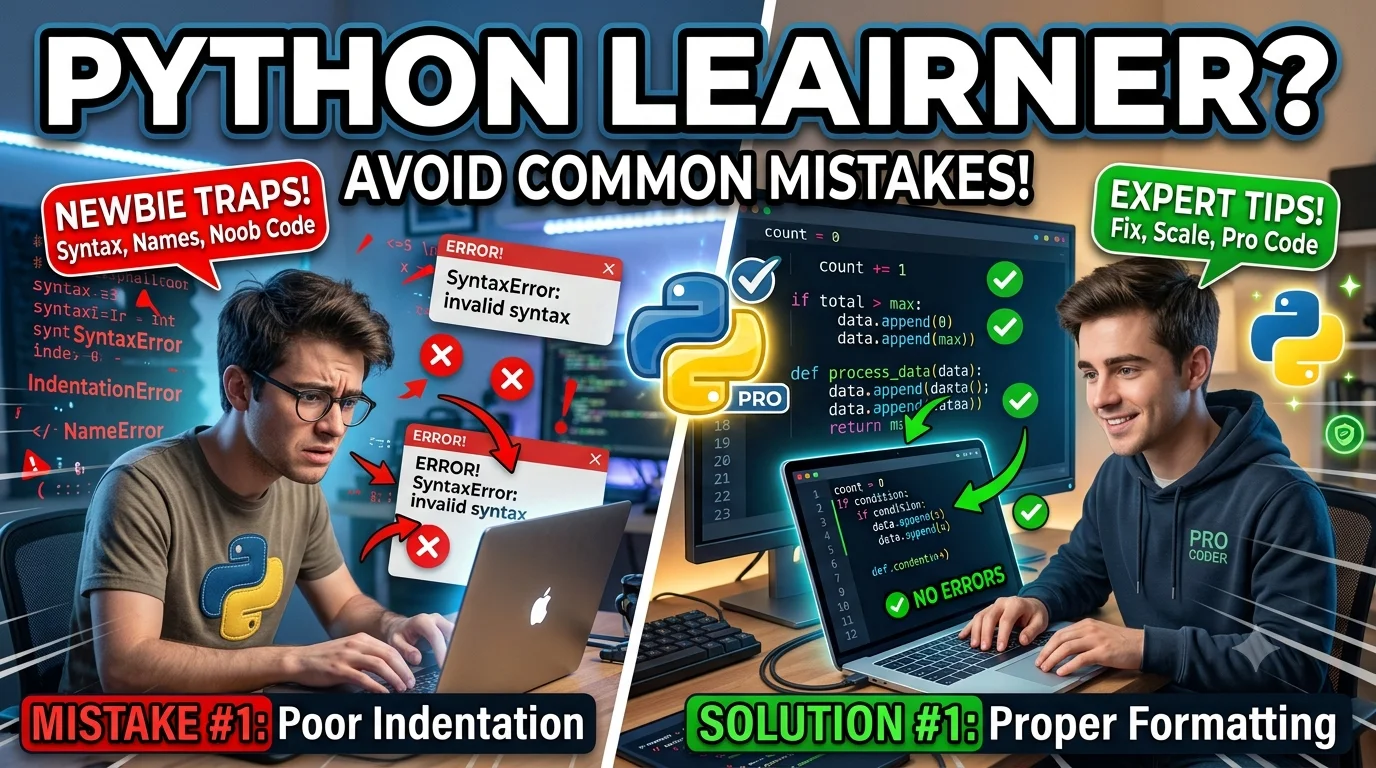
At EEPL Classroom, we have trained hundreds of students, freshers, and working professionals in Python programming, and one pattern is unmistakably clear — almost every beginner makes similar errors while learning this language. If you are searching for the Common Mistakes New Python Learners Make, you are already on the right path, because awareness is the first step towards Python Best Practices. Whether you are a student, a career switcher, or someone exploring our Python Course in Ranchi, understanding these pitfalls early can save you months of confusion and frustration.
Python is often called a beginner-friendly language, but that reputation sometimes gives learners a false sense of ease. The simplicity of Python's syntax hides the depth of logic building and problem-solving skills required to actually become proficient. In this blog, we share practical, experience-based insights from our own classroom sessions at EEPL Classroom, helping you avoid Python Beginner Mistakes and build a strong foundation from day one.
Why Beginners Struggle While Learning Python
Many students join coding classes expecting Python to be "easy" simply because of its readable syntax. However, Python Learning Mistakes usually stem not from the language itself, but from how it is approached. At EEPL Classroom, we have observed that learners who skip fundamentals or rush into advanced topics without practice tend to struggle the most.
The real challenge lies in developing a programmer's mindset — understanding variables, data types, conditional statements, and loops deeply enough to apply them independently, not just recognize them in a textbook.
The Psychological Barrier
Beginners often assume that struggling with code means they are "not cut out" for programming. This is far from true. Every experienced developer has faced the same Python Coding Mistakes you are facing now. The difference is persistence and correct guidance.
Common Mistakes New Python Learners Make
Let us walk through the most frequent errors we encounter while mentoring students in our classroom and online sessions.
1. Skipping the Fundamentals
One of the most common Python Mistakes for Beginners is jumping straight into projects or libraries without mastering the basics. Students often want to build automation scripts or data analysis tools before they understand Python syntax, functions, or basic error handling.
Rushing through variables and data types
Ignoring how indentation affects code execution
Avoiding practice with basic loops and conditionals
This creates fragile knowledge that collapses when real-world problems appear.
2. Not Practicing Enough
Watching tutorials without writing code is possibly the single biggest reason learners fail to retain concepts. Common Python Beginner Mistakes almost always include passive learning — reading or watching without hands-on coding exercises.
At EEPL Classroom, our Python Programming Course in Ranchi is structured around daily practice sessions because muscle memory in coding only develops through repetition.
3. Ignoring Debugging Skills
New learners often panic the moment an error appears. Instead of reading the error message carefully, they either guess randomly or copy-paste solutions without understanding them. Debugging is a core skill, not an inconvenience — and learning to interpret Python's error messages builds long-term confidence.
4. Poor Code Readability
Many beginners write code that works but is impossible to read a week later. Ignoring code readability — using unclear variable names, skipping comments, or writing everything in one giant block — is a mistake that becomes costly as projects grow larger.
5. Avoiding Object-Oriented Programming
Object-oriented programming (OOP) intimidates many beginners because it introduces new ways of thinking about code structure. Avoiding classes and objects out of fear only delays the inevitable, since OOP is essential for real-world software development.
6. Not Learning Version Control
Many self-taught learners never touch Git and GitHub until much later in their journey. This is a mistake, because version control is a standard expectation in almost every internship or job role today, and learning it early builds professional habits.
7. Copy-Pasting Code Without Understanding
With so many resources available online, it is tempting to copy code from forums or AI tools without understanding the logic behind it. This habit prevents genuine logic building and weakens your ability to solve problems independently during interviews or real projects.
8. Not Working on Practice Projects
Theory alone does not make you job-ready. Practice projects — such as building a calculator, a to-do list app, or a simple data analysis script — help translate concepts into applicable skills, something our Job-Oriented Python Course in Ranchi strongly emphasizes.
9. Ignoring the Right Tools
Many beginners write code in plain text editors instead of a proper IDE (Integrated Development Environment), missing out on features like auto-suggestions, error highlighting, and debugging support that significantly speed up learning.
10. Not Exploring Python Libraries Early
Beginners often delay exploring Python libraries like Pandas, NumPy, or Flask, assuming these are "advanced" topics. In reality, early exposure — even at a basic level — helps learners understand Python's real-world applications in automation, data analysis, and software development.
How to Avoid Python Beginner Mistakes
Avoiding these mistakes is not about talent — it is about approach. Here is what we recommend to every student who joins our classroom:
Learn Python syntax thoroughly before jumping to frameworks
Practice daily, even if it's just 30 minutes
Build small practice projects consistently
Read and understand every error message during debugging
Learn Git and GitHub early for professional readiness
Focus on code readability from the very first program you write
The Role of Structured Mentorship
Self-learning through scattered YouTube videos often leads to half-finished knowledge. A structured Python Programming Course in Ranchi, backed by mentorship and doubt-clearing sessions, significantly reduces the trial-and-error phase that most self-taught learners go through.
Why Learn Python the Right Way at EEPL Classroom
At EEPL Classroom, our approach to teaching Python is built around avoiding exactly these mistakes. We are recognized as one of the trusted names when learners search for the Best Python Institute in Ranchi, because our curriculum blends theory with continuous hands-on coding.
Our Python Training in Ranchi covers everything from basic syntax to object-oriented programming, automation, and introductory data analysis, ensuring students don't just learn Python — they learn to think like programmers.
What Makes Our Python Classes in Ranchi Different
Personalized doubt-solving during Python Classes in Ranchi
Practical assignments after every module
Interview preparation alongside our Python Certification Course in Ranchi
Career guidance for freshers, students, and working professionals
Whether you are a college student exploring your first programming language, a fresher preparing for interviews, or a working professional switching careers, our Python Coaching in Ranchi is designed to help you avoid the exact mistakes discussed above.
Final Thoughts
Common Mistakes New Python Learners Make are almost universal, but they are entirely avoidable with the right structure, consistent practice, and expert mentorship. Python rewards patience and logical thinking far more than memorization.
If you are searching for a reliable Best Computer Institute in Ranchi to begin your programming journey the right way, EEPL Classroom's Python Course in Ranchi offers the structured, mentorship-driven approach that helps you skip the common beginner struggles entirely.
FAQs
1. What mistakes do Python beginners make?
Beginners commonly skip fundamentals, avoid daily practice, copy-paste code without understanding logic, and ignore debugging skills. Many also write unreadable code and delay learning object-oriented programming or version control tools like Git and GitHub. These habits create weak foundations that surface later during interviews or real projects. At EEPL Classroom, we address these mistakes early through structured, practice-heavy lessons, ensuring students build genuine problem-solving skills rather than surface-level familiarity with Python syntax and commands.
2. Why is Python difficult for beginners?
Python isn't inherently difficult, but beginners often struggle because they rush into advanced topics without mastering basics like variables, loops, and conditional statements. The difficulty usually comes from weak logic-building rather than the language's syntax. With structured guidance, consistent coding exercises, and mentorship — like what we provide in our Python classes — most learners find Python significantly easier to grasp within a few weeks of focused practice.
3. How can I learn Python without making mistakes?
While making some mistakes is a natural part of learning, you can minimize them by practicing daily, understanding error messages instead of avoiding them, and working on small practice projects consistently. Joining a structured Python Programming Course in Ranchi with mentorship also helps, since experienced trainers can correct misconceptions early, preventing bad coding habits from becoming permanent before they affect your long-term programming growth.
4. How long does it take to learn Python?
Most beginners can grasp Python basics within 6 to 8 weeks with consistent daily practice. However, becoming job-ready with strong problem-solving skills, object-oriented programming knowledge, and practical project experience typically takes 3 to 4 months. The exact duration depends on your practice consistency, prior programming exposure, and whether you're learning through structured mentorship or self-study, which usually takes considerably longer to reach the same skill level.
5. Should I learn Python syntax first?
Yes, understanding Python syntax thoroughly is essential before moving to libraries, frameworks, or advanced concepts. Syntax forms the foundation for writing error-free, readable code. Skipping this step often leads to confusion later when tackling functions, loops, or object-oriented programming. We always recommend students spend adequate time on fundamentals before advancing, as this significantly reduces frustration and mistakes in later stages of learning.
6. Is Python enough to get a job?
Python alone can open doors to roles in automation, data analysis, and scripting, but combining it with problem-solving ability, project experience, and knowledge of Git and GitHub significantly improves employability. Our Job-Oriented Python Course in Ranchi focuses on practical, interview-ready skills rather than just theoretical knowledge, helping freshers and career switchers become genuinely job-market ready, not just certificate holders.
7. How much Python should I practice daily?
Ideally, beginners should practice Python for at least 45 minutes to an hour daily, focusing on writing code rather than just watching tutorials. Consistency matters more than duration — daily coding exercises, even short ones, build stronger logic and retention than occasional long study sessions. This habit-building approach is something we actively encourage among students enrolled in our Python training programs.
8. Which projects should beginners build in Python?
Beginners should start with simple practice projects like a calculator, a to-do list application, a number guessing game, or a basic contact book. As confidence grows, projects involving data analysis with libraries like Pandas or small automation scripts help bridge theory with real-world application, which is exactly the progression we follow in our classroom curriculum.
Introduction
The demand for Java developers in India has never been higher. From startups to multinational corporations, businesses across every sector are actively hiring professionals who can build robust, scalable software and Java remains the language of choice for most of them. If you are a student, fresher, or working professional in Ranchi looking to start a career in software development, choosing the right training institute makes all the difference.
EEPL Classroom is one of the most trusted computer training institutes in Ranchi, helping hundreds of students every year build job-ready skills through structured, practical, and mentor-driven programmes. Our Java Training in Ranchi is specifically designed to take learners from absolute basics to industry-relevant competency regardless of their academic background. Whether you are exploring programming courses in Ranchi for the first time or looking to sharpen your skills before campus placements, EEPL Classroom gives you the environment, curriculum, and support to succeed.
Why Java Remains One of the Most Popular Programming Languages
Before choosing any Java programming course, it helps to understand why Java continues to hold its ground even as newer languages emerge. Java has been in active use for nearly three decades, and its popularity is not accidental, it is built on genuine, lasting utility.
Java powers some of the most critical systems in the world:
Enterprise software development: Large organisations rely on Java for building scalable, secure internal applications and management systems.
Android application development: The majority of Android apps are built using Java, making it essential for mobile developers.
Banking and financial systems: Java's reliability and security features make it the preferred language for banks, insurance companies, and fintech platforms.
Backend web development: Java frameworks like Spring and Hibernate are widely used to build powerful server-side applications.
Long-term career stability: Java consistently ranks among the top five most in-demand programming languages globally, ensuring lasting career relevance.
For anyone serious about a software development course in Ranchi, Java is one of the wisest starting points available.
Why Students Choose EEPL for Java Training in Ranchi
Students and parents across Ranchi frequently ask the same question: with so many options available, why does EEPL Classroom stand out? The answer lies in how we approach training — not just as teaching, but as career preparation.
Industry-Oriented Java Curriculum
Our Java course in Ranchi follows a carefully designed, industry-oriented syllabus that covers every layer of the language. The curriculum is updated regularly to reflect what employers actually ask in interviews and expect on the job.
The core modules include:
Core Java: Data types, control structures, arrays, strings, and input/output handling
Object-Oriented Programming (OOP): Classes, objects, inheritance, polymorphism, abstraction, and encapsulation
Exception Handling: Writing fault-tolerant code that handles runtime errors gracefully
Collections Framework: ArrayList, HashMap, LinkedList, and other essential data structures
JDBC (Java Database Connectivity): Connecting Java applications to real databases like MySQL
Mini Projects: Applying concepts to small, guided projects that reinforce learning through practice
This structured approach ensures that students do not just memorise syntax — they understand how Java works in real development environments.
Practical Learning with Live Coding Sessions
At EEPL Classroom, we believe that reading about code and actually writing code are two completely different experiences. Every session at our institute includes live coding practice, where students write programmes, debug errors, and solve real problems alongside the trainer. This hands-on model significantly improves retention and builds the kind of problem-solving confidence that matters during placements and interviews.
Experienced Trainers and Personal Guidance
Our trainers are not just academically qualified, they bring real-world software development experience into the classroom. They understand what companies look for in a Java developer and teach accordingly. Students receive personalised attention, especially when they are stuck on difficult concepts, which ensures no one is left behind.
Beginner-Friendly Learning Environment
One of the most common concerns among students joining a Java programming course is whether they can manage without a strong technical background. At EEPL Classroom, we start from absolute basics, making the environment welcoming for complete beginners. Students with a background in science, commerce, or even arts have successfully completed our Java programme.
Flexible Batch Timings
We understand that students, college-goers, and working professionals all have different daily schedules. EEPL Classroom offers morning, afternoon, and weekend batches so that learning never comes at the cost of existing commitments.
Hands-On Java Projects That Build Real Skills
Theory alone cannot prepare you for the job market. At EEPL Classroom, every student works on real-world projects during the course. These are not just exercises, they are complete, functional applications that demonstrate your capability to any employer.
Students typically complete projects such as:
Student Management System: A database-driven application to manage student records, fees, and attendance
Banking Application: A Java-based system simulating account creation, deposits, withdrawals, and transaction history
Inventory Management System: A backend application for tracking product stock, purchases, and sales data
Working on these projects teaches students how to think like developers planning structure, handling exceptions, connecting to databases, and testing functionality. This experience dramatically improves both confidence and employability.
Ready to start your Java journey? Contact EEPL Classroom today for a free counselling session and find the right batch for you. Visit our Java Course in Ranchi page to learn more.
Career Opportunities After Completing a Java Course
One of the strongest reasons students invest in a Java course in Ranchi is the breadth of career paths it opens. Java is not a niche skill, it is used across industries and job roles.
After completing training at EEPL Classroom, students are typically prepared for roles such as:
Java Developer: Building and maintaining Java-based applications for companies
Software Developer: Working across the full development lifecycle in product or service companies
Backend Developer: Developing server-side logic, APIs, and database integrations
Android Developer: Creating and deploying mobile applications for the Android platform
Application Support Engineer: Managing, monitoring, and troubleshooting enterprise Java applications
For freshers in India, starting salaries in these roles typically range from ₹2.5 LPA to ₹5 LPA, depending on the company, city, and the candidate's technical depth. With experience and specialisation, this grows substantially.
Java Course with Placement Support in Ranchi
A technical skill alone is not always enough to land your first job presentation, communication, and interview preparation matter equally. EEPL Classroom offers comprehensive placement support as part of its Java programme, making it one of the most complete Java classes in Ranchi available today.
Our placement support includes:
Resume building assistance: Helping students craft a professional, ATS-friendly resume that highlights their Java skills and projects
Mock interviews: Simulated technical and HR interview sessions with detailed feedback
Career counselling: One-on-one guidance on career pathways, job search strategies, and long-term growth
Placement support: Connections to local and national employers actively hiring Java-trained freshers
This end-to-end support is what distinguishes EEPL Classroom from institutes that simply teach and leave students to figure out the rest.
Who Can Join Java Training at EEPL Classroom?
Our Java Training in Ranchi is open to learners from diverse backgrounds. There is no single profile that defines our students, we have trained individuals from almost every walk of life.
The programme is suitable for:
12th-pass students looking to build a technical skill before or alongside college
College students who want to supplement their academic learning with job-ready skills
Graduates entering the job market and needing a practical, verifiable qualification
Working professionals seeking to upskill or transition into a development role
Career switchers from non-technical fields who want to enter the software development industry
If you are willing to learn and put in consistent effort, EEPL Classroom will meet you where you are.
Why EEPL Classroom Stands Out Among Java Training Institutes in Ranchi
When comparing options for a Java course in Ranchi, it is worth evaluating institutes against the features that actually matter for career outcomes.
EEPL Classroom is not just a computer training institute in Ranchi, it is a complete learning ecosystem designed around student success.
Frequently Asked Questions About Why Students Choose EEPL for Java Training in Ranchi
Which is the best Java training institute in Ranchi?
EEPL Classroom is widely regarded as one of the best Java training institutes in Ranchi, offering an industry-oriented curriculum, live projects, and dedicated placement support.
Can I learn Java after 12th?
Yes, absolutely. Java has no strict academic prerequisites. Students who have completed 12th grade from any stream can join and successfully complete our Java programming course.
Is Java a good career option in 2026?
Yes. Java remains one of the most in-demand programming languages globally in 2026. Its applications in enterprise software, Android development, banking systems, and backend development ensure continued hiring across industries.
What is the duration of a Java course?
The Java course at EEPL Classroom is typically completed within 3 to 4 months, covering Core Java, OOP, project work, and interview preparation. Duration may vary slightly based on batch type.
What jobs can I get after learning Java?
After completing a Java course, you can pursue roles such as Java Developer, Software Developer, Backend Developer, Android Developer, and Application Support Engineer, among others.
Does EEPL provide placement support?
Yes. EEPL Classroom provides comprehensive placement support including resume building, mock interviews, career counselling, and employer connections as part of the Java training programme.
Conclusion
Java remains one of the most valuable and versatile programming skills a student can develop in 2026. Its applications span Android development, banking software, enterprise systems, and web backends making it a skill that genuinely opens doors across the industry.
At EEPL Classroom, we have built a programme that goes beyond textbook teaching. Our students gain hands-on experience, real project portfolios, and the placement readiness that the job market demands. From a beginner walking in for the first time to a working professional looking to pivot their career, we have the curriculum, the trainers, and the support structure to help you succeed.
If you are ready to take your first step towards a career in software development, now is the right time. Enquire today, book your free counselling session, and explore the best Java Training in Ranchi at EEPL Classroom. Visit our Java Course in Ranchi page for full details on fees, batch timings, and admissions.
For More Information and Updates
Phone Number: 7488713536
Email ID: eeplclassroom1@gmail.com
Blogs: EEPL Classroom Blogs
Our Platforms
Follow Us on Social Media