
Everything You Need to Know About Modal Verbs for English Learners.
November 19, 2025Mastering Finite and Non-Finite Verbs for Better English.
November 20, 2025Learning phrasal verbs is one of the biggest challenges for English learners—but once you understand them, your sentences become more natural and expressive. Whether you’re a student, teacher, or English learner nearby Ranchi, this guide will simplify phrasal verbs with clear definitions, types, and helpful examples.
What Are Phrasal Verbs?
A phrasal verb is a combination of a verb + preposition or verb + adverb that creates a new meaning.
Examples: turn on, break down, look after, give up
What makes them tricky?
The meaning of the whole phrase is often different from the meaning of the individual words.
Example:
- Break down ≠ break + down
- It actually means to stop working (for machines) or to get very upset (emotionally).
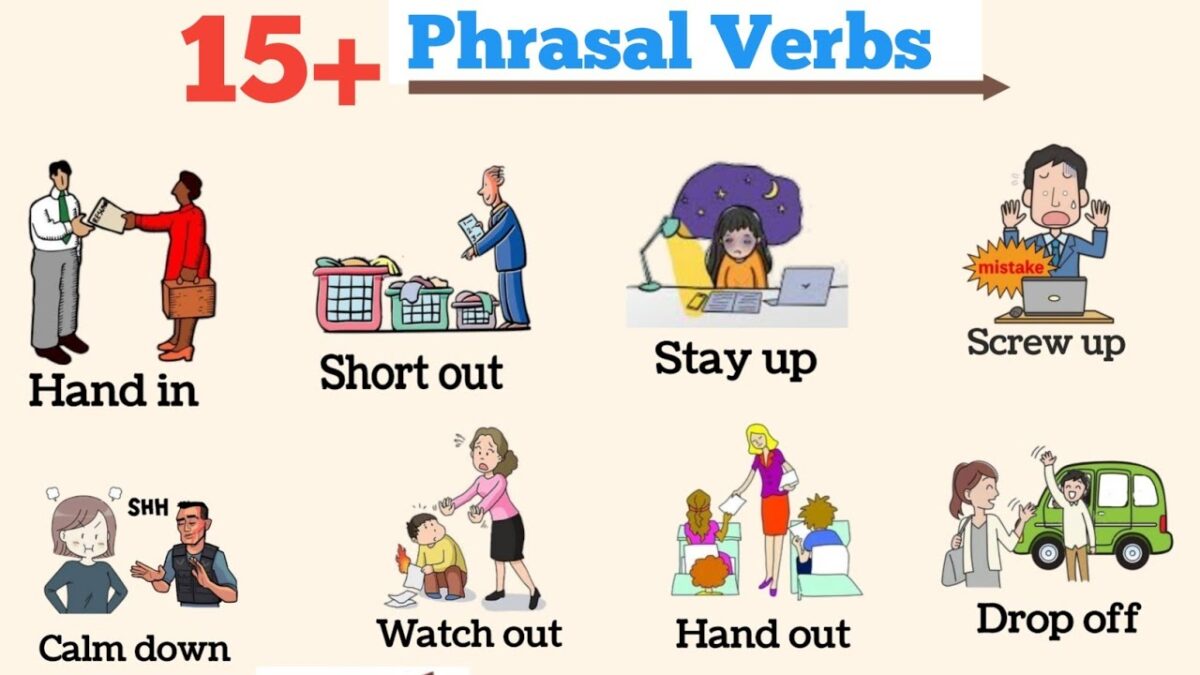
Why Phrasal Verbs Matter for English Learners Nearby Ranchi
If you’re preparing for exams, interviews, or competitive tests nearby Ranchi, mastering phrasal verbs can help you:
- Speak more naturally
- Write more fluently
- Understand native speakers better
- Improve scoring in English sections of exams
Types of Phrasal Verbs
Phrasal verbs are generally divided into four types. Here’s a simple explanation with examples.
1. Transitive Phrasal Verbs (Need an Object)
These phrasal verbs must have an object.
Examples:
- Turn off the fan.
- Bring up a topic.
- Pick up the phone.
Sentence:
- She turned off the light before sleeping.
2. Intransitive Phrasal Verbs (No Object Needed)
These phrasal verbs make sense alone—no object required.
Examples:
- The car broke down.
- He woke up early.
- They went out.
Sentence:
- The bus broke down on the way to Ranchi.
3. Separable Phrasal Verbs
The object can come between the verb and particle.
Examples:
- Turn off the TV → Turn the TV off
- Pick up the bag → Pick the bag up
Sentence:
- Can you pick up the parcel?
- Can you pick the parcel up?
4. Inseparable Phrasal Verbs
The object cannot come between the verb and particle.
Examples:
- Look after (take care of)
- Run into (meet unexpectedly)
- Look for (search)
Sentence:
- She looked after her younger brother.
Common Phrasal Verbs with Clear Examples
1. Look After – take care of
- She looks after her grandmother nearby Ranchi.
2. Give Up – quit
- Don’t give up on your English practice!
3. Bring Up – mention or introduce a topic
- He brought up an interesting question during class.
4. Carry On – continue
- Please carry on with your work.
5. Take Off – remove / become successful / flight departure
- The plane took off on time.
- His business took off quickly.
6. Put On – wear
- She put on her jacket before going out.
Tips to Learn Phrasal Verbs Easily
Here’s how students and learners nearby Ranchi can make learning phrasal verbs simple:
✔ Learn in groups
Group similar phrasal verbs:
- look for, look after, look up, look forward to
✔ Use them in daily conversation
Practice makes them stick.
✔ Create your own sentences
This builds long-term memory.
✔ Watch English shows and interviews
You’ll naturally hear phrasal verbs used in real life.
Conclusion
Phrasal verbs may seem confusing at first, but with the right approach, they become easy to learn and fun to use. Whether you’re studying at home, preparing for exams, or improving communication skills nearby Ranchi, mastering phrasal verbs will help you sound more natural and confident.
Join us today and take the first step toward a successful career in Spoken English!

Anshu Verma
Phone Number: +91-7520011303
Email ID: teamemancipation@gmail.com
Our Platforms:
Digilearn Cloud
EEPL Test
Live Emancipation
Follow Us on Social Media:
Instagram – EEPL Classroom
