
Reflexive vs Relative Pronouns Made Easy — Never Mix Them Up Again!
November 12, 2025Possessive Pronouns Made Simple: Speak English Naturally and Confidently.
November 13, 2025Pronouns are small words, but they play a big role in making your English sound fluent and natural. Even advanced learners often make simple mistakes with pronouns — which can confuse listeners or make your sentences sound awkward. In this blog, we’ll highlight the most common pronoun mistakes and show you how to avoid them, helping you speak English confidently nearby Ranchi.
1. Mixing Up Subject and Object Pronouns
Mistake: Using the wrong pronoun for the subject or object.
❌ Me and Riya went to school.
✅ Riya and I went to school.
❌ Give the book to I.
✅ Give the book to me.
Tip: Remember:
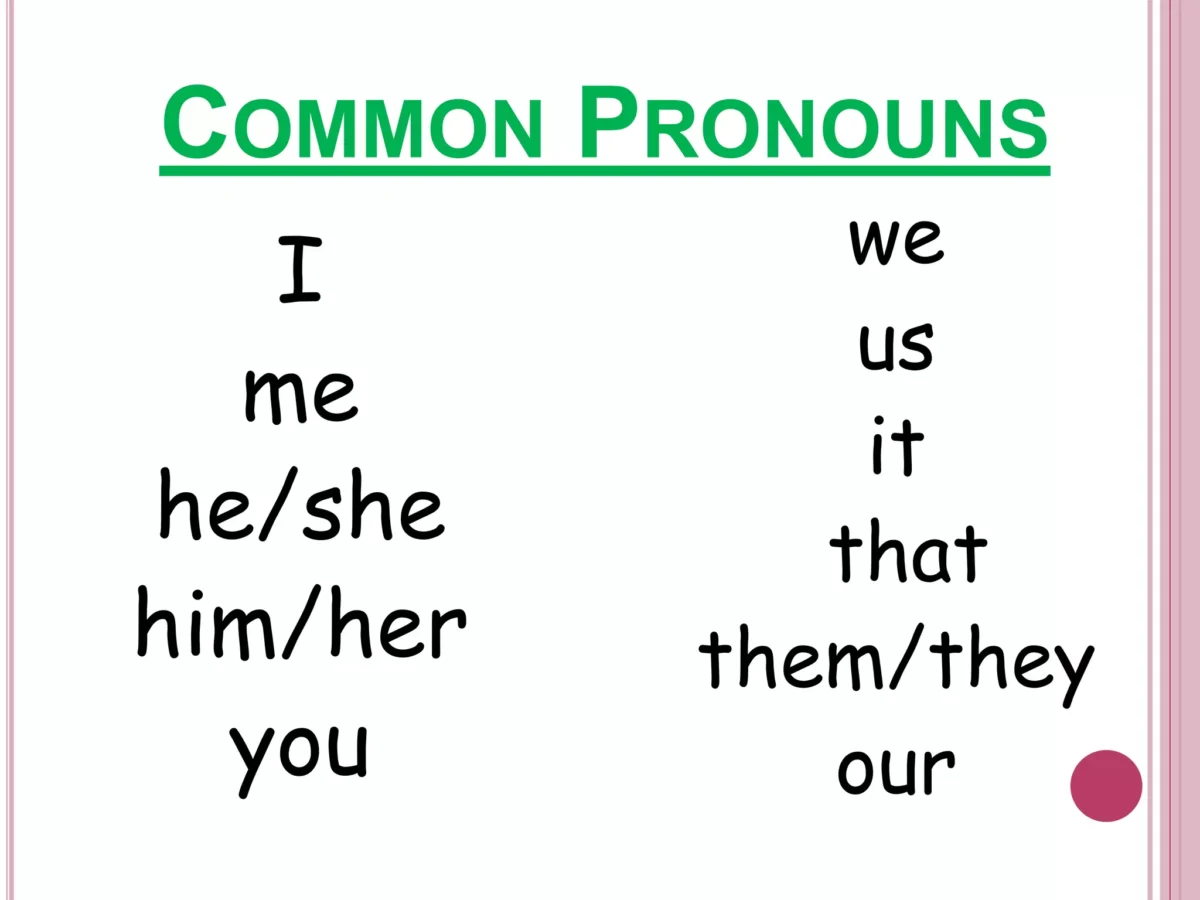
- Subject pronouns (I, you, he, she, we, they) → do the action
- Object pronouns (me, you, him, her, us, them) → receive the action
2. Confusing Possessive Pronouns and Adjectives
Mistake: Mixing “my/mine” or “her/hers.”
❌ This is my pen, that is her’s.
✅ This is my pen, that is hers.
Tip:
- Possessive adjectives (my, your, his, her, our, their) → go before a noun (my book)
- Possessive pronouns (mine, yours, his, hers, ours, theirs) → replace a noun (This book is mine)
3. Using Pronouns Without Clear Reference
Mistake: The pronoun doesn’t clearly point to a noun.
❌ She told her that she would help.
✅ Rina told Sita that she would help.
Tip: Always make sure your pronoun clearly refers to a specific person or thing, so your sentence is easy to understand.
4. Incorrect Gender Pronouns
Mistake: Using the wrong pronoun for gender.
❌ He is a teacher. She is very good at teaching. (if “he” refers to the teacher)
✅ He is a teacher. He is very good at teaching.
Tip: Match he, she, him, her correctly to the person’s gender. For modern English, use they/them for gender-neutral reference.
5. Overusing “Itself,” “Himself,” or “Themselves”
Mistake: Adding reflexive pronouns where they aren’t needed.
❌ Please give it to myself.
✅ Please give it to me.
Tip: Reflexive pronouns like myself, yourself, himself are only for emphasis or when the subject and object are the same.
6. Confusing “Who” and “Whom”
Mistake: Using the wrong relative/interrogative pronoun.
❌ Whom is coming to the party?
✅ Who is coming to the party?
Tip: Use who as the subject of a clause and whom as the object.
Quick Practice Tips
- Read sentences aloud and replace nouns with pronouns to see if it still makes sense.
- Write short stories using I, me, he, she, they correctly.
- Listen to native speakers and notice how they use pronouns naturally.
Final Thoughts
Pronouns may seem small, but mistakes with them can make English sound unnatural or confusing. By avoiding these common errors, you’ll speak more clearly, confidently, and professionally — whether you’re chatting with friends or writing emails nearby Ranchi.
Join us today and take the first step toward a successful career in Spoken English!
Anshu Verma
Phone Number: +91-7520011303
Email ID: teamemancipation@gmail.com
Our Platforms:
Digilearn Cloud
EEPL Test
Live Emancipation
Follow Us on Social Media:
Instagram – EEPL Classroom
