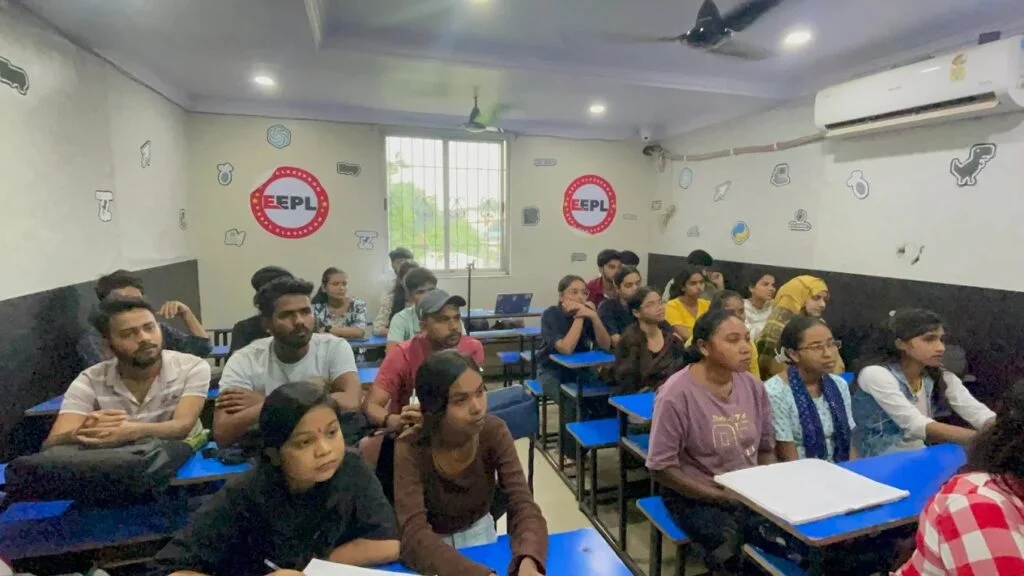


Chemistry is often called the “central science” because it connects physics, biology, and environmental science. At the heart of chemistry lies chemical bonding, a fundamental concept that explains how atoms combine to form molecules, compounds, and ultimately, all the substances around us. For Class 11 CBSE students and JEE aspirants, understanding chemical bonding is not just about cracking exams—it is about appreciating the science that governs life and nature itself. At EEPL Classroom, Plaza Chowk, Ranchi, we ensure students build a strong foundation in such topics, making them exam-ready as well as conceptually sharp.
What is Chemical Bonding?
Atoms are the building blocks of matter, but they rarely exist independently. To achieve stability, atoms interact with one another by either sharing, donating, or accepting electrons. This interaction leads to the formation of chemical bonds.
The three primary types of bonds are:
- Ionic Bond – transfer of electrons (e.g., NaCl).
- Covalent Bond – sharing of electrons (e.g., H₂O, CO₂).
- Metallic Bond – delocalized electron sharing in metals (e.g., Fe, Cu).
These simple interactions are responsible for the existence of everything we see—from the air we breathe to the food we eat.
Importance of Chemical Bonding in Nature
1. Foundation of Life
The molecules of life—DNA, proteins, carbohydrates, and lipids—are held together by covalent and hydrogen bonds. Without chemical bonding, complex biological structures could never exist, and life as we know it would be impossible.
2. Water – The Universal Solvent
The polar covalent bond in water makes it a unique molecule. Hydrogen bonding between water molecules gives it special properties like high boiling point, surface tension, and the ability to dissolve many substances. This property sustains life on Earth.
3. Atmospheric Stability
Oxygen (O₂), nitrogen (N₂), and carbon dioxide (CO₂) are bound by strong covalent bonds, ensuring atmospheric stability. Ozone (O₃), formed through bonding rearrangements, protects life by absorbing harmful UV radiation.
4. Energy and Fuel
The combustion of fuels like coal, petroleum, and natural gas involves breaking and forming chemical bonds, releasing enormous energy. Bond energy is the basis of all energy transformations, including photosynthesis and respiration.
5. Materials and Technology
Metals, alloys, plastics, and ceramics derive their strength, conductivity, and flexibility from different bonding types. For instance, metallic bonding gives copper its conductivity, making it useful in wiring, while covalent bonds in diamond make it the hardest natural material.
Importance in JEE Mains & Advanced
For aspirants of IIT-JEE, chemical bonding is a high-weightage topic. Every year, multiple questions are asked from concepts like:
- Hybridization
- Molecular Orbital Theory (MOT)
- VSEPR Theory
- Bond parameters (bond length, bond angle, bond enthalpy)
- Resonance and polarity
A strong understanding not only helps in chemistry but also strengthens problem-solving in physical and organic chemistry, where bonding concepts are repeatedly applied.
How EEPL Classroom, Ranchi Helps You Master It
At EEPL Classroom, Plaza Chowk, Ranchi, we go beyond textbook teaching to ensure students develop clarity and confidence in topics like chemical bonding. Here’s how we help:
- Conceptual Clarity – Our expert faculty explains difficult concepts like hybridization and molecular orbital theory with simple real-life analogies.
- Visualization Tools – Use of molecular models, diagrams, and digital presentations to make abstract ideas more concrete.
- Exam-Oriented Approach – Special focus on JEE pattern questions, previous year papers, and mock tests to improve accuracy.
- Doubt-Solving Sessions – Personalized attention ensures every student clears their queries, no matter how small.
- Integrated Learning – Linking Class 11 NCERT syllabus with JEE-level applications to strengthen long-term memory.
Our Benefits at EEPL Classroom
- Experienced Faculty Team with years of expertise in CBSE & JEE coaching.
- Small Batch Size for focused learning.
- Regular Tests & Assignments to track progress.
- Comprehensive Study Material designed for both school exams and competitive exams.
- Motivational Guidance to keep students disciplined and stress-free.
- Central Location at Plaza Chowk, Ranchi for easy accessibility.
Conclusion
Chemical bonding is not just a chapter in Class 11 Chemistry—it is the foundation of nature itself. From the water we drink to the air we breathe, from the food we eat to the energy we use, everything depends on bonding between atoms. For JEE aspirants, mastering this topic is essential for achieving success in one of the toughest entrance exams in India.
At EEPL Classroom, Plaza Chowk, Ranchi, we help students understand, apply, and excel in chemical bonding, building a strong foundation for both board exams and JEE. With expert guidance and the right strategy, students can confidently turn complex concepts into stepping stones toward their dream careers.
For More Information and Updates, Connect With Us*
- Name: Survi
- Phone Number: +91-7488713635
- Email ID: survi@eepl.me
- Our Platforms:
- Digilearn Cloud
- EEPL Test
- Live Emancipation
- Follow Us on Social Media:
- Instagram – EEPL Classroom
- Facebook – EEPL Classroom
- https://eepl.me/blogs/
Stay connected and keep learning with EEPL Classroom!