Top 10 Skills Every Data Analyst Needs in 2026
Planning a data analyst career? Here are the top 10 data analyst skills employers look for in 2026, from SQL and Python to data storytelling.
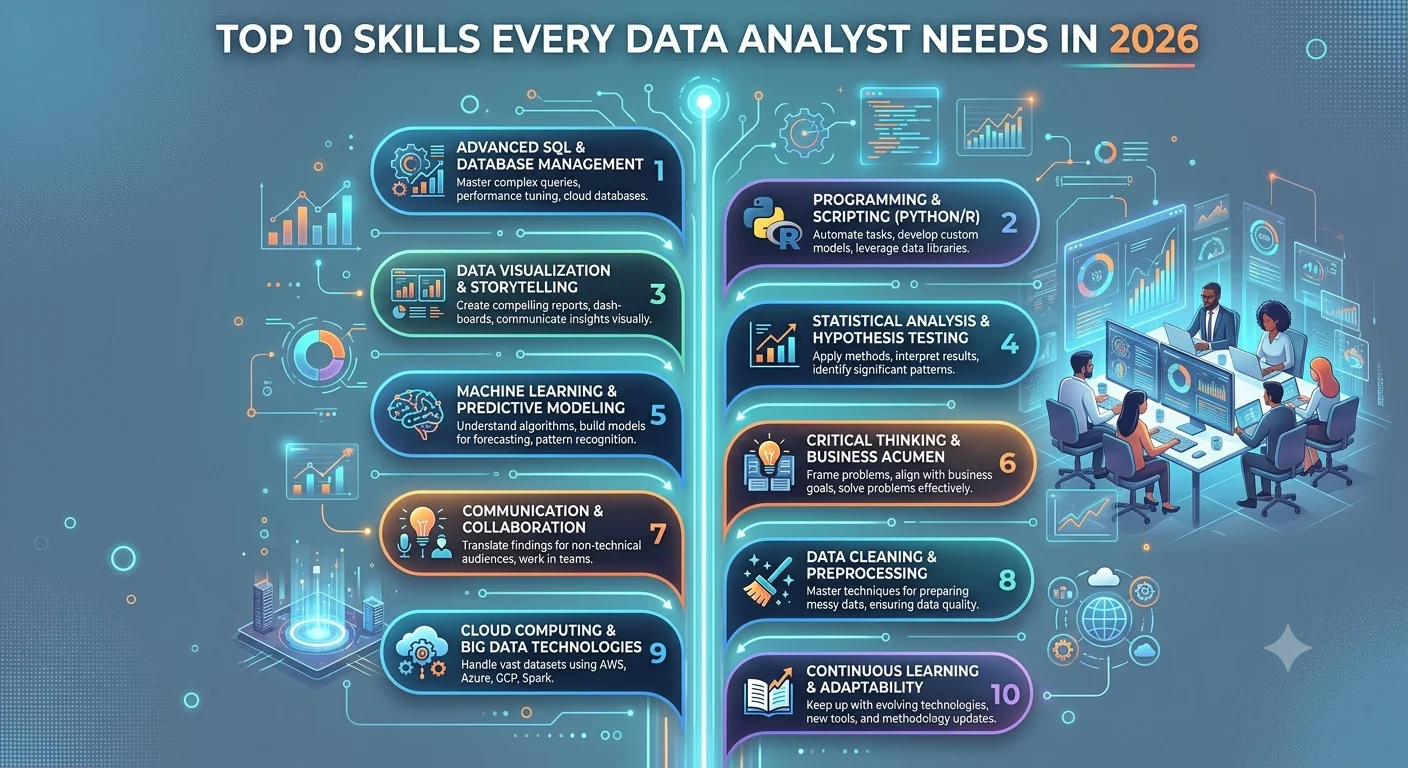
The data analyst skills job market has matured significantly over the past few years. It's no longer enough to know basic Excel formulas and call yourself job-ready — employers in 2026 expect a specific, well-rounded skill set that covers technical tools, statistical thinking, and communication ability. If you're planning to build a career as a data analyst, or currently evaluating a data analytics course, understanding exactly which skills matter — and why — will help you focus your learning instead of trying to cover everything at once.
This guide breaks down the ten skills that consistently show up across data analyst job descriptions, interviews, and real workplace expectations, in the order most employers actually prioritise them.
1. Microsoft Excel (Advanced Level)
Excel remains the most universally used tool in data analytics, and despite predictions that it would be replaced by more advanced tools, it hasn't gone anywhere. What's changed is the expectation of depth. Employers in 2026 don't just want someone who can build a basic pivot table — they want analysts comfortable with:
Advanced formulas (INDEX-MATCH, nested IFs, array formulas)
Pivot tables and pivot charts for quick summarisation
Data cleaning techniques for messy, real-world datasets
Building simple dashboards directly within Excel
Excel is often the first tool a data analyst touches in any organisation, simply because it's already installed everywhere and requires no special access requests. Strong Excel skills remain the fastest way to prove immediate usefulness in a new role.
2. SQL (Structured Query Language)
If there's one technical skill that separates a serious data analyst candidate from a beginner, it's SQL. Almost every company stores its operational data in relational databases, and being able to pull, filter, and join that data directly — rather than waiting for someone else to export it — is a foundational expectation now, not a bonus skill.
Core SQL skills employers look for include:
Writing SELECT queries with WHERE, GROUP BY, and HAVING clauses
JOIN operations across multiple tables
Aggregate functions (SUM, COUNT, AVG) for summarising data
Subqueries and basic query optimisation
A data analyst who can independently query a database, rather than relying entirely on pre-built reports, is significantly more valuable to any team.
3. Python for Data Analysis
Python has become the de facto second technical skill after SQL, primarily because of how well it handles data manipulation, automation, and analysis at scale. You don't need to become a software engineer — but functional comfort with the following is expected:
Pandas for data manipulation and cleaning
NumPy for numerical operations
Basic data visualisation using Matplotlib or Seaborn
Writing simple scripts to automate repetitive reporting tasks
Python's real advantage over Excel is handling datasets too large or too messy for spreadsheets to manage efficiently — something increasingly common as companies collect more data than ever before.
4. Data Visualisation and BI Tools (Power BI / Tableau)
Knowing how to analyse data is only half the job — being able to present findings clearly to non-technical stakeholders is equally important, and this is where Power BI and Tableau come in. These tools let analysts build interactive dashboards that let managers explore data themselves, rather than waiting for a new report every time a question comes up.
Skills that matter here include:
Connecting and cleaning data sources within the BI tool
Choosing the right chart types for different data stories
Building interactive filters and drill-down dashboards
Publishing and sharing reports securely with stakeholders
In 2026, dashboard-building has become one of the most visible and valued deliverables a data analyst produces, since leadership teams interact with these reports daily.
5. Statistical Thinking
This is less about memorising formulas and more about knowing which statistical concept applies to which business question. Employers expect analysts to be comfortable with:
Descriptive statistics (mean, median, mode, standard deviation)
Understanding correlation versus causation
Basic probability and distributions
Simple regression analysis for trend identification
Statistical thinking is what separates someone who can run a query from someone who can correctly interpret what the results actually mean — a distinction that matters enormously when decisions are being made based on your analysis.
6. Data Cleaning and Preparation
Ask any working data analyst what takes up most of their time, and the honest answer is usually data cleaning — not analysis. Real-world data is messy: missing values, inconsistent formatting, duplicate records, and human entry errors are the norm, not the exception.
Strong data cleaning skills include:
Identifying and handling missing or null values appropriately
Standardising formats (dates, currencies, categorical labels)
Detecting and removing duplicate or erroneous records
Validating data against expected ranges or business logic
This skill doesn't get much attention in casual conversations about data analytics, but it's often the single biggest differentiator between analysts who produce reliable insights and those who don't.
7. Business and Domain Understanding
A data analyst who understands the business context behind the numbers consistently outperforms one who only knows the technical tools. Understanding your company's industry — whether it's retail, finance, healthcare, or logistics — shapes how you interpret data and what questions you know to ask in the first place.
This includes:
Understanding key business metrics and KPIs relevant to the industry
Knowing what "good" or "bad" numbers actually look like in context
Recognising which findings are actually actionable for the business
Asking the right clarifying questions before starting an analysis
This is one reason capstone projects across multiple industries — e-commerce, finance, healthcare — are so valuable during training; they build this contextual instinct before you're expected to have it on the job.
8. Data Storytelling and Presentation
Technical accuracy means little if you can't communicate your findings in a way that drives action. Data storytelling is the skill of translating numbers into a clear narrative that non-technical stakeholders can act on.
This involves:
Structuring findings around a clear business question, not just raw data
Choosing visuals that support the story rather than overwhelm it
Avoiding jargon when presenting to leadership or cross-functional teams
Recommending specific next steps, not just reporting numbers
Many technically skilled analysts get overlooked for promotions simply because they haven't developed this skill — it's often the deciding factor in who gets invited to strategic conversations.
9. Critical Thinking and Problem Framing
Before writing a single query, strong data analysts spend time understanding what question they're actually trying to answer. This skill is frequently underestimated but heavily valued by employers, since poorly framed analysis wastes time and can lead to wrong conclusions even with perfect technical execution.
This includes:
Breaking a vague business question into a specific, answerable one
Identifying what data is actually needed versus what's merely available
Recognising when a finding is statistically significant versus coincidental
Questioning assumptions in the data itself before trusting conclusions
This is a skill best developed through real project work and mentorship, rather than passive learning, since it requires practising judgment repeatedly.
10. Continuous Learning and Tool Adaptability
The specific tools used in data analytics continue to evolve, and the analysts who stay relevant are the ones comfortable picking up new tools quickly rather than treating their current skill set as fixed. In 2026, this increasingly includes basic familiarity with AI-assisted analytics tools, which are becoming common additions to traditional BI platforms.
This means:
Staying current with updates to core tools like Excel, SQL, and Power BI
Being willing to learn new platforms as companies adopt them
Understanding the fundamentals well enough to transfer skills across tools
Following industry trends in data analytics through communities, courses, or reading
Analysts who treat their skill set as a foundation to keep building on, rather than a finished checklist, consistently have longer and more successful careers in this field.
How to Build These Skills Systematically
Trying to learn all ten of these skills through scattered YouTube videos or free tutorials is possible, but it's slow and easy to leave gaps, particularly in statistical thinking, business context, and data storytelling — skills that are harder to self-teach than pure technical tools.
A structured data analytics course in Ranchi that combines Excel, SQL, Python, Power BI, statistics, and real capstone projects — under live instructor guidance — builds these skills in the right sequence, with immediate feedback when you get something wrong. This is particularly valuable for skills like data storytelling and business framing, which are difficult to evaluate on your own without a mentor pointing out blind spots.
Frequently Asked Questions About Top 10 Skills Every Data Analyst Needs
What is the most important skill for a data analyst in 2026?
SQL is generally considered the most foundational technical skill, since almost every company stores data in relational databases that analysts need to query directly.
Do I need to know Python to become a data analyst?
Yes, functional Python skills — particularly Pandas and NumPy — are increasingly expected, especially for handling larger or messier datasets than Excel can manage efficiently.
Is Excel still relevant for data analysts in 2026?
Absolutely. Excel remains one of the most widely used tools in data analytics, and advanced Excel skills are still a baseline expectation in most data analyst job descriptions.
What soft skills matter most for data analysts?
Data storytelling, critical thinking, and business context understanding are the most valued non-technical skills, since they determine whether your technical analysis actually leads to business action.
Can I learn all these data analyst skills through an online course?
You can learn the technical tools online, but skills like data storytelling, critical thinking, and business framing are typically developed faster with live mentorship and real project feedback.
How long does it take to build these skills from scratch?
Most structured data analytics training programmes, including hands-on courses covering all ten of these areas, take approximately 3 to 6 months to build genuine job-readiness.
If you're serious about building a data analyst career in 2026, the goal isn't to master every tool overnight — it's to build these ten skills systematically, with real projects that force you to apply them the way employers actually expect.
For More Information and Updates
Phone Number: 7488713536
Email ID: eeplclassroom1@gmail.com
Blogs: EEPL Classroom Blogs
Our Platforms
Follow Us on Social Media