Data Analyst vs Data Analytics: What's the Real Difference?
Confused between Data Analyst and Data Analytics? Learn the real difference, career paths, and which Data Analytics Course in Ranchi prepares you for both.
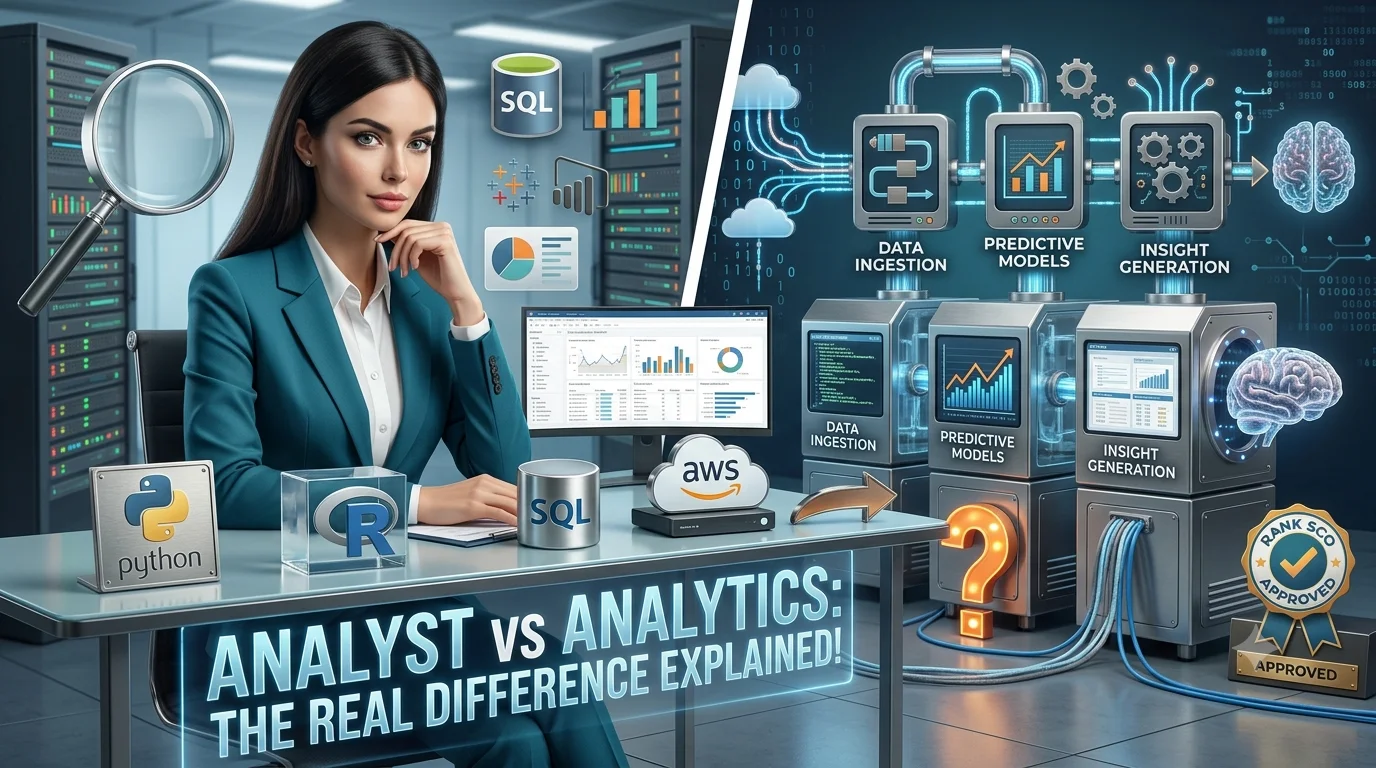
If you've been searching for a data analyst course or a data analytics course in Ranchi, you've probably noticed something confusing — job postings, course listings, and even institutes seem to use these two terms interchangeably. Are they the same thing? Do you need two different courses? At EEPL Classroom, this is one of the most common questions we get from students walking into our institute, and it's worth clearing up properly before you enrol anywhere.
The short answer: Data Analyst is a job role, while Data Analytics is the skill set and process behind that role. But the details matter, especially when you're choosing a course and planning a career. This article breaks down exactly what separates them, where they overlap, and how a single well-structured data analytics training programme like the one we run at our EEPL Classroom can prepare you for both.
What Is Data Analytics?
Data analytics is the process of examining raw, unstructured, or messy data to draw meaningful conclusions. It involves collecting data, cleaning it, applying statistical methods, and presenting findings in a way that helps a business make better decisions.
Think of data analytics as a discipline similar to how "accounting" is a discipline. It includes tools, techniques, and a defined process:
Collecting data from multiple sources (databases, spreadsheets, APIs, surveys)
Cleaning and preparing that data so it's usable
Applying statistical or analytical techniques to find patterns
Visualising and communicating findings clearly
Data analytics is not tied to one job title. It's a capability that a business analyst, a marketing manager, an operations lead, or a dedicated data analyst can all apply in their respective roles.
What Is a Data Analyst?
A Data Analyst is a specific job role. It's the person whose primary responsibility is to apply data analytics techniques daily — pulling data, running queries, building dashboards, and answering business questions with evidence rather than guesswork.
A typical data analyst's day might include:
Writing SQL queries to extract data from company databases
Building Excel or Power BI dashboards for weekly reporting
Identifying why a particular product's sales dropped last month
Presenting findings to managers or leadership teams
So while data analytics is the what — the discipline and toolkit — a data analyst is the who, the person whose job title centres around applying that toolkit. Every data analyst uses data analytics, but not everyone who uses data analytics is a data analyst by title.
Why This Confusion Happens So Often
This mix-up isn't unique to Ranchi or India — it happens globally, and there are a few real reasons behind it:
Job postings are inconsistent. Companies frequently list "Data Analytics" as a required skill inside a "Data Analyst" job description, and sometimes even use "Data Analytics Executive" as a job title itself, blending the two terms.
Course marketing overlaps intentionally. Training institutes (including many in Ranchi) often name their programmes "Data Analytics Course" because it's the broader, more searched term — even though the course is training you to become a Data Analyst by profession.
The skills genuinely overlap 90%. Since a data analyst's core job is applying data analytics, almost every technical skill — Excel, SQL, Python, Power BI, statistics — is identical whether you call the course one name or the other.
This is exactly why at EEPL Classroom, our Data Analytics Course in Ranchi is deliberately built to prepare you for Data Analyst roles specifically, rather than treating the two as separate learning tracks.
Key Differences at a Glance
While the overlap is significant, there are a few genuine distinctions worth understanding:
Scope: Data analytics is broader and can apply across roles (business analyst, marketing analyst, financial analyst). Data analyst is a narrower, dedicated title.
Depth of tool usage: A data analyst is expected to use tools like SQL, Python, and BI platforms daily and at depth. Someone applying data analytics occasionally (like a marketing manager checking a dashboard) may only need surface-level familiarity.
Career trajectory: "Data analytics" as a skill can support many career paths — business analytics, data science, MIS reporting. "Data analyst" is usually the specific entry point into the broader data careers ecosystem.
Job market visibility: Recruiters usually post openings under "Data Analyst," "Junior Data Analyst," or "Business Data Analyst" — rarely under "Data Analytics" as a standalone title.
Which Should You Learn — Or Is It Even a Choice?
For most students in Ranchi researching this topic, the honest answer is: you don't need to choose. A well-designed data analytics course should already prepare you for data analyst roles as a natural outcome, not as a separate add-on.
When evaluating any data analyst course or data analytics course near me, check whether the curriculum actually includes:
SQL for querying real business data
Python (Pandas, NumPy) for data manipulation
Excel for reporting and dashboards
Power BI or Tableau for visualisation
Real capstone projects, not just theory
If a course covers all of this, it's functionally training you as a data analyst — regardless of what the course is titled.
How EEPL Classroom Bridges Both
At EEPL Classroom, our Data Analytics Course in Ranchi is structured around this exact overlap. Rather than treating "data analyst" and "data analytics" as two different products, we built one comprehensive programme that covers:
Foundational statistics and Excel for data analysis
SQL for data analysts, covering queries, joins, and relational databases
Python for data analytics, including Pandas and NumPy
Power BI and Tableau for business dashboards
Real capstone projects across e-commerce, finance, and healthcare datasets
Interview preparation specifically for data analyst roles, including resume and portfolio building
This means whether you came looking for a "data analyst course" or a "data analytics course," you land in the same well-rounded, job-ready programme.
Career Outcomes After This Training
Once trained, students typically move into roles such as:
Data Analyst
Business Analyst
MIS Executive
Reporting Analyst
Market Research Analyst
Junior Data Scientist, with further upskilling
Entry-level data analysts in Ranchi and similar cities typically start between ₹2.5 LPA and ₹4.5 LPA, with growth to ₹6 LPA and beyond as SQL, Python, and Power BI skills mature.
Frequently Asked Questions About Data Analyst vs Data Analytics
Is data analyst and data analytics the same course?
Not exactly the same term, but in practice, a good data analytics course trains you to become a data analyst. The skills and tools overlap almost entirely.
Should I search for "data analyst course" or "data analytics course" in Ranchi?
Either search should lead you to the same type of training. What matters more is checking the curriculum — look for SQL, Python, Excel, and Power BI, rather than focusing on the course title alone.
Can a data analytics course get me a data analyst job?
Yes. A well-structured data analytics course, especially one with real projects and interview preparation, directly prepares you for data analyst job roles.
Do I need to know coding to become a data analyst?
Basic Python and SQL are commonly required, but most reputable courses, including ours at EEPL Classroom, teach these from the ground up assuming no prior coding background.
Is data analytics a good career choice in 2026?
Yes. Data-driven decision-making continues to grow across banking, retail, healthcare, and government sectors, keeping demand for trained data analysts consistently high.
How long does it take to become job-ready as a data analyst?
Most structured programmes, including EEPL Classroom's data analytics training, take 3 to 6 months to build job-ready skills, depending on the batch pace and prior background.
Does EEPL Classroom's course prepare students for both data analyst and business analyst roles?
Yes. The curriculum is designed broadly enough to prepare students for Data Analyst, Business Analyst, MIS Executive, and Reporting Analyst roles, since these all rely on the same core analytics skill set.
If you're still deciding between a data analyst course and a data analytics course in Ranchi, the simplest path forward is to join a programme that genuinely covers both — which is exactly what our Data Analytics Course in Ranchi is built to do.
For More Information and Updates
Phone Number: 7488713536
Email ID: eeplclassroom1@gmail.com
Blogs: EEPL Classroom Blogs
Our Platforms
Follow Us on Social Media