Data Analyst vs Business Analyst: Which Career Path Should You Choose?
Confused between a Data Analyst and Business Analyst career? Compare roles, skills, salaries, and growth paths to choose the right one for you.
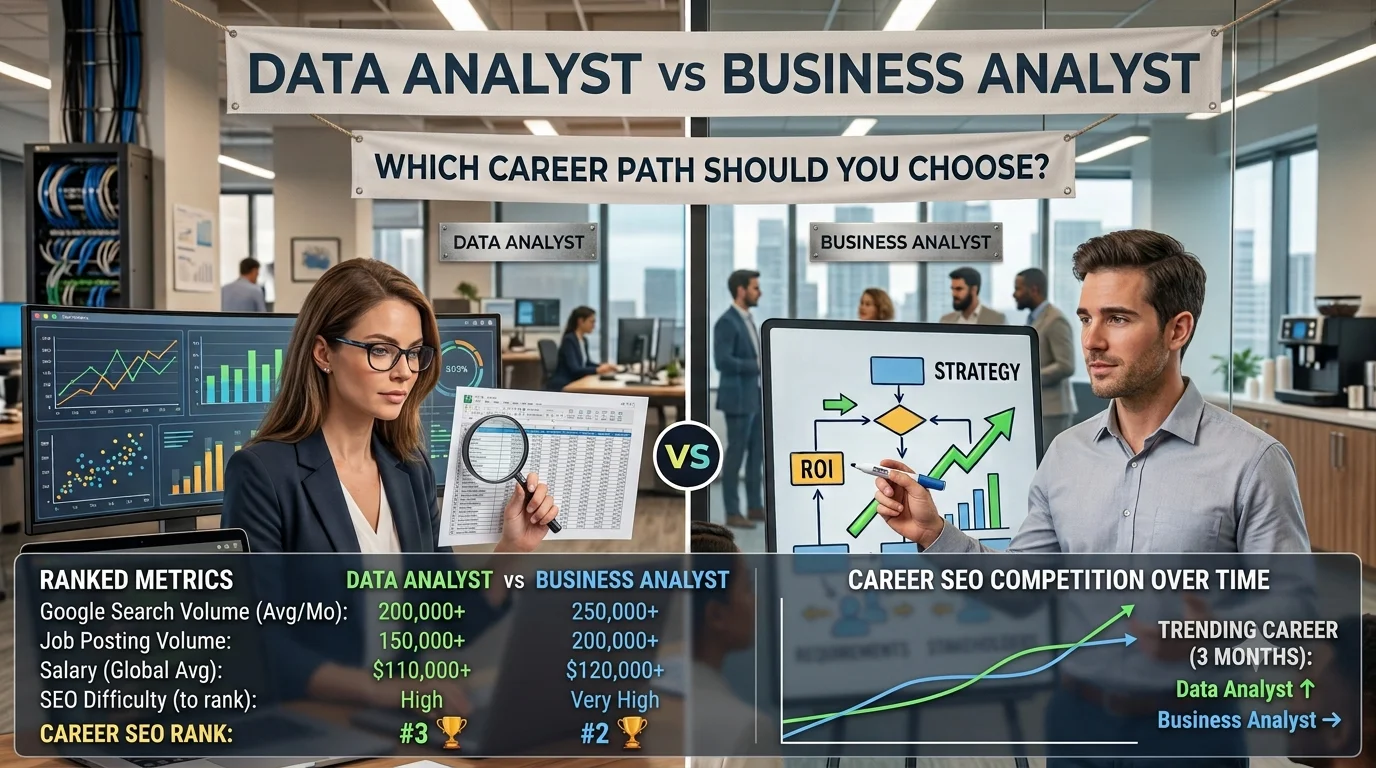
If you've been researching data careers, you've likely come across two roles that sound similar but lead to genuinely different day-to-day work: Data Analyst and Business Analyst. Both involve working with data, both are in high demand, and both often get lumped together in course marketing and job listings, but the actual responsibilities, required skills, and career trajectories differ more than most people realize.
At EEPL Classroom, this is one of the most common questions students ask us before enrolling in our Data Analytics Course in Ranchi. This guide breaks down exactly what separates these two roles, what skills each requires, and how to figure out which path genuinely fits you — rather than choosing based on title alone.
What Does a Data Analyst Actually Do?
A Data Analyst works primarily with numbers, databases, and technical tools to extract patterns and insights from raw data. Their core responsibility is answering specific, data-driven questions — why did sales drop last quarter, which product category is underperforming, what does customer churn look like by region.
A typical data analyst's daily work includes:
Writing SQL queries to pull data from company databases
Cleaning and preparing messy datasets for analysis
Building dashboards in Power BI or Tableau for reporting
Running statistical analysis to identify trends and patterns
Presenting findings through charts, reports, and visualisations
Data analysts spend most of their time closer to the data itself — querying it, cleaning it, and turning it into visual, digestible insights for others to act on.
What Does a Business Analyst Actually Do?
A Business Analyst, by contrast, sits closer to business strategy and process improvement. Their job isn't primarily about running queries — it's about understanding business problems, gathering requirements from stakeholders, and recommending solutions that may or may not involve data analysis directly.
A typical business analyst's daily work includes:
Meeting with stakeholders to understand business requirements
Documenting current processes and identifying inefficiencies
Translating business needs into requirements for technical teams
Recommending process improvements or new systems
Bridging communication between business teams and IT/data teams
Business analysts spend more time in conversations, documentation, and stakeholder management than in technical tools — though many do use Excel, basic SQL, or dashboards to support their recommendations.
The Core Difference in One Sentence
If you want the simplest possible distinction: a Data Analyst answers "what does the data say?", while a Business Analyst answers "what should the business do about it?"
Both roles work with data and business problems, but a data analyst goes deep into the technical extraction and analysis, while a business analyst goes wide across stakeholders, processes, and strategic recommendations. In many organisations, especially larger ones, a data analyst's output actually feeds directly into a business analyst's recommendations — they work in sequence, not in isolation.
Skills Comparison
Here's how the required skill sets actually diverge:
Data Analyst skills:
SQL (essential, non-negotiable in most roles)
Python or R for data manipulation
Excel (advanced level)
Power BI or Tableau for visualisation
Statistics and probability fundamentals
Business Analyst skills:
Requirements gathering and documentation
Process mapping (flowcharts, process diagrams)
Stakeholder communication and negotiation
Basic Excel and sometimes SQL (not always required)
Domain/industry knowledge (finance, healthcare, retail, etc.)
The overlap exists mainly in Excel and basic data literacy — but a data analyst's technical depth in SQL, Python, and visualization tools is rarely matched by a typical business analyst, whose strength lies instead in communication and process thinking.
Educational Background and Entry Point
Both roles are accessible from a wide range of educational backgrounds, which is part of why they attract similar student profiles. Neither role strictly requires a computer science degree.
Data analyst roles tend to favor candidates with:
Comfort with numbers, logic, and technical tools
Willingness to learn SQL and Python from scratch
Attention to detail in data cleaning and validation
Business analyst roles tend to favor candidates with:
Strong verbal and written communication skills
Comfort speaking with stakeholders across departments
Interest in business strategy and process improvement, not just numbers
If you enjoy solving structured problems using tools and code, data analyst work will likely feel more natural. If you enjoy talking to people, understanding processes, and translating business needs into action, business analyst work may suit you better.
Salary Comparison in India
Salary ranges for both roles are broadly comparable at the entry level, though business analyst salaries can climb slightly higher with experience, particularly in consulting-heavy industries.
Based on current market data for cities like Ranchi and similar Tier 2 markets:
Data Analyst: approximately ₹3 LPA to ₹6.2 LPA depending on experience and skill depth
Business Analyst: approximately ₹4 LPA to ₹8 LPA depending on domain expertise and stakeholder-facing responsibility
Business analyst salaries often edge higher at senior levels because the role increasingly overlaps with strategic decision-making and requires broader organisational trust — but data analyst roles offer a faster, more clearly defined technical skill ladder for beginners to climb.
Career Growth Paths
Both roles offer strong long-term trajectories, but they diverge in direction over time.
Data Analyst career progression typically moves toward:
Senior Data Analyst
Business Intelligence (BI) Analyst
Data Scientist (with additional machine learning skills)
Analytics Manager
Business Analyst career progression typically moves toward:
Senior Business Analyst
Product Manager
Business Consultant
Strategy or Operations Manager
Interestingly, many professionals move between these paths over their careers — a data analyst who develops strong stakeholder communication skills can transition into business analysis, and a business analyst who develops technical skills can move into data analytics. The two paths aren't mutually exclusive long-term; they're often complementary at different career stages.
Which Role Suits You? A Simple Self-Check
Ask yourself these questions to get clarity:
Do you enjoy working with tools like SQL, Python, and Excel more than meetings? → Lean Data Analyst
Do you enjoy talking to stakeholders and understanding business processes more than writing code? → Lean Business Analyst
Are you comfortable with statistics and technical problem-solving? → Lean Data Analyst
Are you naturally good at documentation, requirement-gathering, and negotiation? → Lean Business Analyst
Do you want a clearer, tool-based skill ladder to climb as a beginner? → Lean Data Analyst
Do you want a role with broader exposure to business strategy early on? → Lean Business Analyst
If you find yourself answering "both" to several of these, that's common — many professionals genuinely enjoy elements of each, and there's no rule that says you have to pick permanently on day one.
Why Data Analytics Training Is a Strong Starting Point Either Way
Here's something worth knowing before you decide: many successful business analysts started their careers with data analytics training, simply because understanding how to read and interpret data makes you a far more effective business analyst later. SQL, Excel, and basic statistics aren't wasted skills if you eventually move toward business analysis — they make your stakeholder recommendations more credible, since you can back them with actual data rather than intuition alone.
This is one reason our Data Analytics Course in Ranchi at EEPL Classroom works well as a starting point regardless of which direction you eventually lean toward. The technical foundation — SQL, Python, Excel, Power BI — gives you the option to specialise deeper into data analyst roles, or pivot toward business analyst work later with a stronger data-literacy advantage than most business analyst-only training provides.
Frequently Asked Questions About Data Analyst vs Business Analyst
Is a data analyst the same as a business analyst?
No. A data analyst focuses on extracting and analysing data using technical tools like SQL and Python, while a business analyst focuses on understanding business problems and recommending solutions, often relying on data analysts' output rather than producing it themselves.
Which pays more, data analyst or business analyst?
At the entry level, salaries are broadly similar. At senior levels, business analyst roles can sometimes pay slightly more due to closer involvement in strategic decision-making, though this varies significantly by industry and company.
Can a data analyst become a business analyst later?
Yes, this is a common transition. Data analysts who develop strong stakeholder communication and process understanding often move into business analyst or product management roles over time.
Do I need to choose between data analyst and business analyst training?
Not necessarily. A strong data analytics foundation, including SQL, Excel, and basic statistics, supports both career paths and keeps your options open as you gain experience and clarity on which role you prefer.
Which role is better for someone who doesn't enjoy coding?
Business analyst roles generally require less hands-on coding and rely more on communication and process skills, making them a better fit for people who prefer stakeholder-facing work over technical tools.
Does EEPL Classroom's course prepare students for business analyst roles too?
Yes. While our Data Analytics Course in Ranchi is primarily focused on data analyst skills, the strong foundation in Excel, SQL, and business analytics principles also supports students who later move toward business analyst roles.
Whether you lean toward the technical depth of data analysis or the strategic, people-facing world of business analysis, building a strong data literacy foundation early gives you the flexibility to move in either direction as your career and interests develop.