Common Mistakes Ranchi Students Make During JEE Preparation | And How to Avoid Them
Discover the most common mistakes Ranchi students make during JEE preparation and learn practical tips to avoid them. Improve your IIT JEE strategy today.
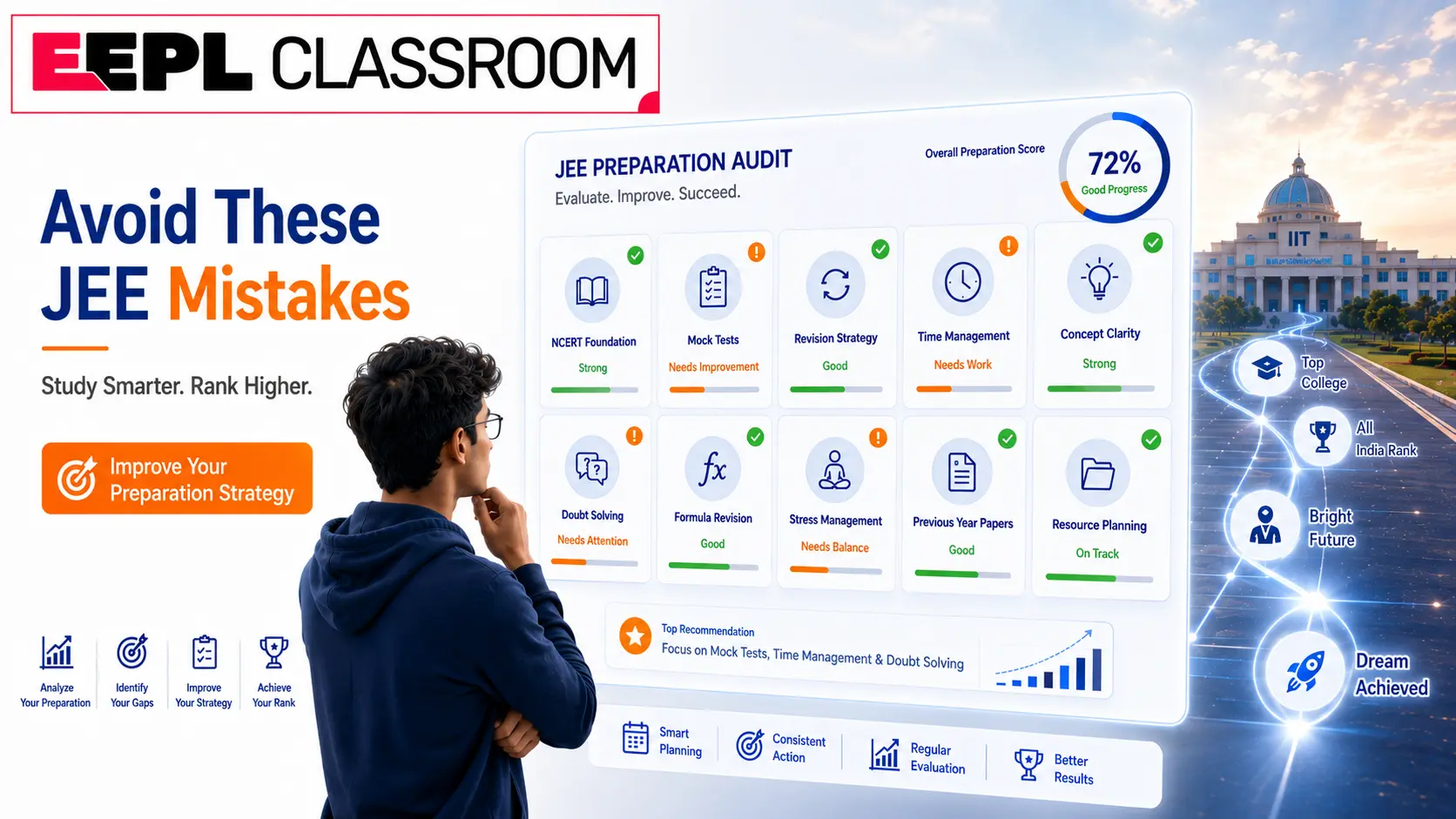
Every year, thousands of students across Jharkhand sit down with one goal to crack JEE Main and JEE Advanced and secure a seat in an IIT, NIT, or top engineering college. The ambition is real. The effort is genuine. And yet, a large number of these students, many of them talented and hardworking, do not get the result they deserve. Not because they lacked potential, but because they made avoidable mistakes during preparation that quietly cost them marks and momentum. At EEPL Classroom, one of Ranchi's trusted JEE coaching centres, we have worked with hundreds of JEE aspirants and observed these patterns closely. This blog is written for those students — and for the parents who support them, so that common mistakes can be identified early and corrected before they become costly. Visit EEPL Classroom to explore how we help JEE aspirants build smarter preparation strategies.
Before we go into the mistakes, one thing must be said clearly: making mistakes during preparation is not a sign of failure. It is part of the process. What matters is whether you recognise them and course-correct in time. So read this with an open mind not as a list of things to feel bad about, but as a practical checklist to make your JEE preparation sharper and more effective.
Mistake 1: Ignoring NCERT and Rushing to Reference Books
This is perhaps the single most common and most damaging mistake that JEE aspirants in Ranchi make. The moment they join a coaching class or start preparing seriously, many students immediately reach for advanced reference books HC Verma, DC Pandey, J.D. Lee — and treat NCERT as something too basic to bother with.
This is a serious strategic error. NCERT textbooks form the conceptual foundation of JEE Main, and a significant number of questions particularly in Chemistry are directly based on NCERT content. Students who skip NCERT in favour of advanced books often end up with shaky fundamentals that collapse under the pressure of actual exam conditions.
The right approach is to master NCERT first, completely and thoroughly, and then move to reference books for deeper practice. The NCERT official website provides free access to all textbooks — there is no excuse for skipping them.
Mistake 2: Following an Unrealistic Study Timetable
Ask any JEE aspirant in Ranchi to show you their study timetable, and many will produce a schedule that looks impressively disciplined on paper — 14 to 16 hours of study per day, every subject covered daily, no breaks, no flexibility. And then ask them how long they actually followed it. The answer is usually two to three days.
An unrealistic JEE study plan is worse than no plan at all, because it sets you up for repeated failure and erodes your confidence every time you cannot stick to it. The right timetable is one that is ambitious but achievable — built around your actual energy levels, your school or coaching schedule, and your personal learning pace.
A well-designed JEE preparation schedule should include:
Dedicated subject blocks with clear topics for each session
Short breaks every 45 to 90 minutes to maintain focus
Weekly revision slots, not just new topic coverage
One lighter day per week to allow mental recovery
Flexibility built in for unexpected disruptions
JEE time management is not about studying the maximum number of hours. It is about studying the right topics with the right level of focus, consistently, over the full preparation period.
Mistake 3: Skipping Mock Tests and Previous Year Question Papers
Many students in Ranchi treat mock tests as something to do at the very end of preparation — a final check before the exam. This is one of the most expensive mistakes a JEE aspirant can make.
Mock tests and previous year question papers (PYQs) are not just assessment tools. They are training tools. They teach you how the exam thinks, what types of questions are repeated across years, how to manage your time across 75 questions in three hours, and how to handle the psychological pressure of a timed, high-stakes test. Students who take regular mock tests from early in their preparation consistently outperform those who save them for the last month.
The National Testing Agency (NTA) provides official mock tests and previous year question papers for JEE Main on its portal. These are an essential and completely free resource that every aspirant must use consistently throughout the year.
Performance analysis after each mock test is equally important. Do not just check your score — study every wrong answer, understand why you got it wrong, and identify whether the error was conceptual, calculation-based, or time-management-related. This analysis is where real improvement happens.
Mistake 4: Trying to Cover Everything Instead of Mastering Priority Topics
IIT JEE preparation involves a vast syllabus across Physics, Chemistry, and Mathematics. One of the most common mistakes students make is trying to cover every topic in equal depth, treating high-weightage chapters and low-weightage chapters as equally important.
This approach leads to surface-level coverage of everything and deep mastery of nothing. A student who has studied 100% of the syllabus at 60% depth will almost always underperform compared to a student who has studied 80% of the syllabus at 90% depth, focusing on the chapters that consistently carry the most marks.
Smart JEE preparation requires prioritisation. Chapters like Mechanics, Electrostatics, Optics in Physics; Organic Chemistry, Coordination Compounds, Electrochemistry in Chemistry; and Calculus, Coordinate Geometry, Algebra in Mathematics carry disproportionately high weightage across both JEE Main and JEE Advanced. Master these first. Build depth before breadth.
Mistake 5: Weak Concept Clarity and Formula Memorisation Without Understanding
Ranchi students like students everywhere sometimes fall into the trap of memorising formulas and solution patterns without understanding the underlying concept. This works fine for predictable questions but breaks down completely when the exam presents a question in an unfamiliar format or combines two concepts in an unexpected way.
JEE Advanced in particular is designed to test concept clarity and problem-solving skills not memory. If you can solve a standard problem on projectile motion but cannot answer a variation that adds a new constraint, it means your understanding of the concept is incomplete. The solution is not to practice more problems of the same type, it is to go back to the concept, understand it from first principles, and then practice varied applications.
Coaching guidance from experienced faculty is particularly valuable here. A good teacher does not just show you how to solve a problem, they explain why that approach works, what the underlying physical or mathematical principle is, and how to recognise similar problems in different forms.
Mistake 6: Avoiding Doubt Clearing and Studying in Isolation
Many students in Ranchi are reluctant to ask questions in coaching classes, to teachers, or even to peers. This reluctance comes from different places: hesitation to appear slow, fear of judgement, or simply not knowing how to articulate the doubt clearly. But unresolved doubts are compounding problems. A concept that is not understood today becomes a gap that makes tomorrow's topic harder.
Self-study is essential for JEE preparation, but studying entirely in isolation without access to expert feedback, doubt resolution, or guided problem-solving sessions significantly limits your growth. This is one of the core reasons why structured JEE coaching classes in Ranchi add genuine value: they provide a framework of accountability, regular doubt clearing, and expert course correction that self-study alone cannot replicate.
If you are preparing with the support of structured JEE Coaching in Ranchi, make full use of every doubt-clearing session available to you. Never let a doubt sit unresolved for more than 24 hours.
Mistake 7: Poor Revision Strategy
Studying a topic once and moving on is not preparation, it is an illusion of preparation. Revision strategy is one of the most underestimated elements of JEE preparation, and its absence is responsible for a significant number of underperformances on exam day.
The human brain forgets information rapidly without reinforcement. Research on memory retention consistently shows that information reviewed at spaced intervals after one day, one week, and one month is retained far more durably than information studied once in depth and then left untouched. This is the principle behind spaced repetition, and it should be the backbone of every JEE aspirant's revision plan.
Effective revision at EEPL Classroom is structured as follows:
Daily review of that day's concepts before sleeping
Weekly revision of all topics covered in that week
Monthly full-chapter revision with practice questions
Formula and reaction revision sheets maintained as quick-reference tools
Every topic you study should enter a revision cycle immediately, not be placed in a "to revise later" pile that never gets revisited.
Mistake 8: Neglecting Mental Health and Stress Management
JEE preparation is a marathon, not a sprint. And yet many aspirants in Ranchi approach it like a sprint — studying at unsustainable intensity, sacrificing sleep, skipping physical activity, withdrawing from social interaction, and treating every bad mock test score as a crisis. This pattern leads to burnout, anxiety, and a sharp decline in performance at precisely the moment it matters most.
Stress management is not a luxury during JEE preparation, it is a strategic necessity. A student who sleeps seven to eight hours, exercises regularly, and maintains a degree of emotional balance will almost always outperform an equally talented student who is chronically sleep-deprived and anxious. The brain consolidates learning during sleep. Problem-solving ability declines sharply under chronic stress. These are not motivational statements, they are neurological facts.
Parents play a critical role here. Supportive, patient engagement from parents asking how the student is feeling, not just how the preparation is going makes a meaningful difference to a JEE aspirant's resilience and confidence over a long preparation period.
Mistake 9: Using Too Many Books and Resources Simultaneously
Walk into any serious JEE aspirant's room in Ranchi and you are likely to find a stack of ten or more books multiple reference books for each subject, several sets of module notes from different sources, printed study material, and online resources from three different platforms. This is resource overload, and it is a surprisingly common trap.
The problem is not the books themselves, many are excellent. The problem is that switching between too many resources prevents you from going deep into any one of them. How to prepare for JEE effectively is not about collecting the most resources, it is about choosing the right two or three resources per subject and mastering them completely.
A focused resource list for JEE looks something like this:
Physics: NCERT + HC Verma (concepts) + DC Pandey or coaching modules (practice)
Chemistry: NCERT (essential) + J.D. Lee for Inorganic + coaching notes for Organic and Physical
Mathematics: NCERT + R.D. Sharma or coaching modules + previous year papers
Choose your resources, commit to them, and go deep. Depth beats breadth every single time in engineering entrance preparation.
Mistake 10: Starting Too Late or Losing Momentum Midway
Many students in Ranchi start serious JEE preparation in Class 12 by which point a full year of foundational Class 11 content has been either partially studied or studied without the rigour that JEE demands. Class 11 concepts in Physics and Mathematics are not just background knowledge they are directly tested in both JEE Main and JEE Advanced. Starting late creates a deficit that is very difficult to overcome in the remaining time.
Equally damaging is the student who starts well in Class 11 but loses momentum in the middle of Class 12 often due to board exam pressure, burnout, or a string of discouraging mock test scores. Consistency over 18 to 24 months is the real differentiator between students who crack JEE and those who come close but fall short.
If you are a Class 12 student or a dropper reading this, the right response is not panic, it is prioritisation. Identify your weakest high-weightage topics, build a realistic catch-up plan, and execute it with consistency. It is not too late to make meaningful improvements before the exam.
Frequently Asked Questions – JEE Preparation Mistakes
1. What are the biggest mistakes students make during JEE preparation?
The most impactful mistakes include skipping NCERT, avoiding mock tests, studying without a realistic study timetable, neglecting revision, and trying to cover the entire syllabus at the expense of depth in high-weightage topics. Poor stress management and studying in complete isolation without doubt-clearing support also significantly hurt performance.
2. Is NCERT enough for JEE Main?
NCERT is essential but not entirely sufficient on its own. For Chemistry, NCERT covers the majority of what is needed for JEE Main and should be mastered completely. For Physics and Mathematics, NCERT builds the conceptual foundation, but additional practice from standard reference books or coaching modules is needed to handle the full range of problem types that appear in the exam.
3. How many hours should a JEE aspirant study daily?
Quality matters more than quantity. Most JEE toppers study between 6 to 10 hours per day, but with high focus, structured topic coverage, and regular short breaks. A student studying 14 hours with poor focus and no revision plan will almost always underperform a student studying 8 focused, well-planned hours. Build your JEE study plan around sustainable intensity, not maximum hours.
4. Why are mock tests important for JEE?
Mock tests simulate actual exam conditions, time pressure, question variety, and psychological intensity. Regular mock testing builds speed, accuracy, and exam temperament. Performance analysis after each test identifies conceptual gaps and helps you adjust your preparation strategy. The NTA portal provides official mock tests that should be used throughout the year.
5. How can students avoid burnout during JEE preparation?
Burnout is avoided through sustainable scheduling, realistic daily targets, adequate sleep (7 to 8 hours), regular physical activity, and at least one lighter study day per week. Students and parents should treat mental health as a preparation priority, not an afterthought. Identifying early signs of burnout, persistent fatigue, inability to concentrate, loss of motivation — and adjusting the schedule accordingly is far better than pushing through until performance collapses.
6. Should I use multiple reference books for JEE?
No. Using too many books is a common and damaging mistake. Choose one or two quality references per subject, complete them thoroughly, and supplement with previous year papers and coaching modules. Jumping between too many books creates superficial coverage and prevents the depth that JEE Advanced in particular demands.
7. Can average students crack JEE with proper planning?
Absolutely. JEE preparation rewards consistency, smart strategy, and genuine concept clarity over raw talent. Many students who were not top rankers in school have cracked JEE and secured seats in NITs and even IITs by following disciplined preparation, focusing on high-weightage topics, and using mock tests and revision effectively. The right plan, executed consistently, matters more than starting ability.
8. How can coaching help improve JEE preparation?
Structured JEE coaching classes provide expert faculty guidance, a tested curriculum, regular doubt-clearing sessions, mock tests, and peer motivation all of which are difficult to replicate through self-study alone. Good coaching guidance helps students avoid the mistakes outlined in this article by providing course correction before errors compound. If you are looking for trusted IIT JEE coaching in Ranchi, explore what EEPL Classroom offers through our JEE Coaching in Ranchi programme.
Final Word | Preparation That Is Smarter, Not Just Harder
Cracking JEE Main and JEE Advanced is genuinely hard. But it becomes significantly harder when avoidable mistakes quietly undermine months of sincere effort. The students who succeed are not always the ones who studied the longest, they are the ones who studied with the most clarity, consistency, and self-awareness.
Recognise the mistakes. Build a smarter plan. Use every resource available to you, including expert JEE coaching support, official resources from the Joint Entrance Examination portal, and the guidance of teachers who understand your specific challenges as a student preparing in Ranchi and Jharkhand.
Your preparation deserves to be as good as your ambition. Make every hour count.